 Plays from YouTube
Sing-along · Science & Nature · Grades 1–2
Amphibians
 Dr. Lewicki, PhD · On YouTube since Nov 22, 2026
Water first, then land: that is an amphibian.
Amphibians is a two-minute sing-along about amphibians: frogs, toads and salamanders that start life in water and live on land: the chorus asks and children shout the answers. Made for first and second grade in the K-2 Sing-Alongs from Dr. Lewicki, PhD.
Parts of the song · 6
Lyrics
Tap a line to play the video from there.
Chorus
Verse 1
Chorus
Verse 2
Final Chorus
Outro
Lesson · read it together
Let's learn: amphibians
Frogs, toads, salamanders and newts are amphibians: they start life in water, and most live on land when grown. Read this part together, follow the frog from water to land, and tap a pink button to hear that part of the song.
After this lesson, children can
- Name amphibians: frogs, toads, salamanders and newts.
- Tell how they start in water (eggs, babies with gills) and grow lungs and legs.
- Say why they have moist skin and stay near water.
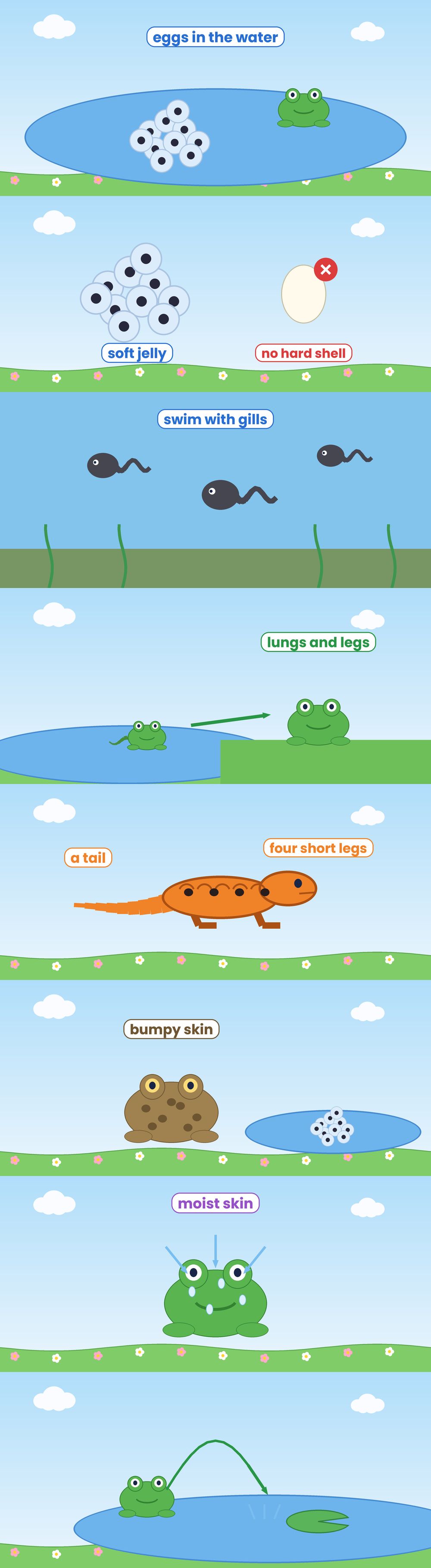
Most lay their eggs in water, soft and round. No hard shell, just jelly. 1Eggs in the water
Most amphibians lay their eggs in water.
The eggs are soft, like jelly. They have no hard shell like a bird's egg.
The babies swim with gills, then grow. 2Babies swim with gills
Baby frogs are called tadpoles. They live in water.
Tadpoles breathe with gills, like fish.
Lungs and legs, and out they go. 3Lungs and legs, out on land
As they grow, tadpoles grow lungs and legs.
Then the grown-up frog can hop out onto land.
A salamander has a tail and four short legs. A toad has bumpy skin. 4Salamanders and toads
A salamander is an amphibian with a long tail and four short legs.
A toad is like a frog, but with bumpy skin. It lays its eggs in water too.
They breathe a little through their skin, so they stay near water. 5Moist skin
Amphibians have smooth, moist skin. They breathe a little through it!
Their skin must stay wet, so they stay near water and hop back in.
Key words
- amphibian
- An animal that starts life in water and lives on land when grown, like a frog.
- tadpole
- A baby frog that swims with gills.
- gills
- Body parts for breathing in water.
- moist
- A little bit wet.
- salamander
- An amphibian with a tail and four short legs.
Try it: amphibian or not?
Tap Amphibian or Not an amphibian for each animal.
- a frogFrogs start life in water as tadpoles.
- a lizardLizards have dry scales. They're reptiles.
- a toadToads lay eggs in water too.
- a turtleTurtles are reptiles with dry scales.
- a fishFish stay in water their whole lives.
Quick quiz
Read each question out loud. Children call out the answer, then tap it.
1. Water first and then on land, it's an...?
Show the answer
Amphibian. Amphibians start in water and move to land.
2. Where do baby frogs swim and grow?
Show the answer
In water. Tadpoles live in water.
3. Smooth and wet, they have...?
Show the answer
Moist skin. Amphibians have moist skin.
4. Do amphibian eggs have hard shells?
Show the answer
No, soft jelly. Their eggs are soft, like jelly.
For grown-ups: teaching this lesson
Time: 15 to 20 minutes, first and second grade.
- Play the song once all the way through.
- Read the five parts above together. Follow the frog from egg to land with your finger.
- Play it again. Pause before each chorus answer so the class can call it out.
- Do the amphibian-or-not game together.
- Draw the frog's life: eggs, tadpole, froglet, frog, with arrows. Exit question: why do amphibians stay near water?
Talk about it
- How is a tadpole like a fish? (It lives in water and breathes with gills.)
- How is a frog different from a lizard? (Moist skin vs. dry scales.)
- Why are amphibian eggs laid in water? (They have no shell and would dry out.)
Standards and resources
- Builds toward 3-LS1-1Develop models to describe that organisms have unique and diverse life cycles but all have in common birth, growth, reproduction, and death.
Teach it next
For teachers
Free to use in class. Play it a few times; it's made to support what students learn in class, not replace it.
About this song
Amphibians is a two-minute sing-along for first and second grade about amphibians: frogs, toads and salamanders that start life in water and live on land, with a drawing on screen for every line. The chorus asks and children shout the answers: Water first and then on land, it's an? Amphibian! Where do baby frogs swim and grow? Water! Where can grown-up frogs hop around? Land! Smooth and wet, they have? Moist skin! The verses see soft jelly eggs with no hard shell laid in water, babies that swim with gills and then grow lungs and legs, a salamander with a tail and four short legs, a toad with bumpy skin, and why amphibians stay near water.
How to use it in class Play it once all the way through. Play it again and pause before each answer in the chorus so the class can call it out. On the third play, turn the sound down on the chorus and let them sing it.
K-2 Sing-Alongs
Posts this song's page (video, lyrics and quiz) to a class in Google Classroom.
Spot a mistake? Tell us. Every fix is listed on the Corrections page.
Check yourself
How do baby frogs breathe in the water? Why do amphibians stay near water?
Show the answer
With gills. They breathe a little through their moist skin.
Key terms
- frog toad salamander
- frog life cycle
- science sing along
- sing along
Lesson pack
Want a free lesson pack for this song?
A lyric sheet with section times, fill-in-the-blank with a word bank, a vocabulary list, a 10-question quiz and exit tickets, all with answer keys. Free for classroom use.
Pick “A lesson pack for one of the songs” on the form and name this song.
Song details
- Subject
- Science & Nature
- Grades
- 1–2
- Length
- 2:04
- Topic
- Amphibians: frogs, toads, salamanders and newts start life in water and most live on land as adults; they have smooth, moist skin and lay soft eggs in water
- On YouTube
- Nov 22, 2026
- Collection
- K-2 Sing-Alongs
- Music style
- Bright acoustic children's folk-pop, 112 BPM major-key bounce with unhurried phrasing and held notes; warm clear female lead sings a simple narrow-range melody in dry, up-front half-spoken talk-sing, while children shout each answer after a beat of space; clear foreground vocals, chorus starts right away; strummed ukulele, handclaps, plucked upright bass and glockenspiel chimes carry the verses into a full-group final chorus and children-led outro.
- Lead vocal
- Female
- Made with
- Music made with Suno AI from lyrics written for this lesson; drawings and video by Dr. Lewicki, PhD