 Plays from YouTube
Base pairs, the double helix, replication song · Science · Grades 7–8
DNA Structure Song
 Dr. Lewicki, PhD · On YouTube since Nov 17, 2026
Four letters, two strands, one code.
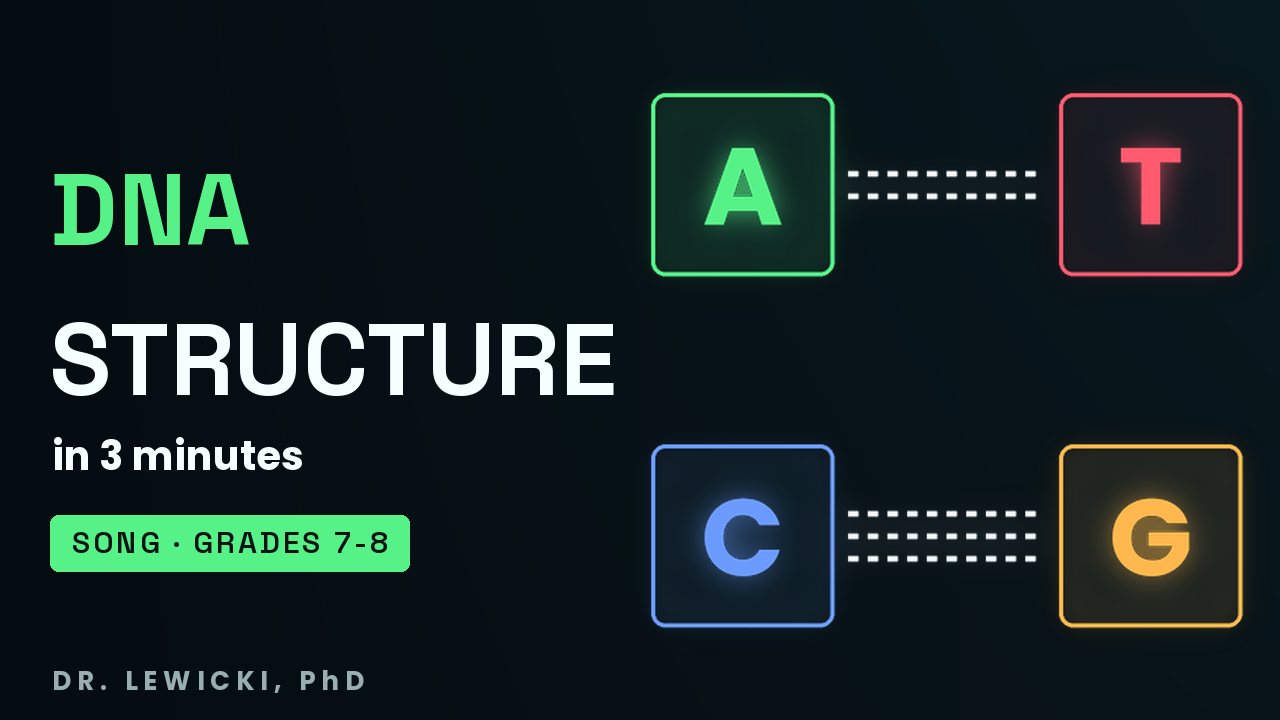
The DNA Structure Song is DNA in three minutes: the chorus asks four questions and the crowd shouts the answers (T, G, sugar and phosphate, double helix), then one strand is worked into its partner and copied. Made for grades 7-8 in the Dr. Lewicki, PhD Science Series.
Parts of the song · 10
Lyrics
Tap a line to play the video from there.
Chorus
Verse 1
Chorus
Verse 2
Chorus
Bridge
Final Chorus
Outro
Lesson · textbook notes
The lesson: DNA structure
Every living cell carries DNA, the instructions for building and running the organism. This lesson follows the song: the parts of DNA, the pairing rule, the shape, and how DNA copies itself. Every picture is from the video, and each Hear it button plays that part of the song.
By the end of this lesson you can
- Name the three parts of a nucleotide.
- State the base-pairing rule (A with T, C with G) and use it to write a complementary strand.
- Describe the double helix: a sugar-phosphate backbone on the outside, base pairs on the inside.
- Explain how DNA copies itself, and why each copy keeps one old strand.

DNA, deoxyribonucleic acid, is a long chain-like molecule. The DNA in one human cell would stretch about 2 meters, yet it packs into a nucleus about 6 micrometers across. 1What DNA is
DNA (deoxyribonucleic acid) is the molecule that stores an organism's genetic instructions. In your cells it sits in the nucleus, and it is passed from parents to offspring.
DNA is extremely long and extremely thin. Packing it tightly is what lets so much information fit inside one tiny cell.
Each nucleotide has a phosphate, a sugar (deoxyribose) and a base. The chain repeats the same plan again and again. 2Nucleotides: the building blocks
DNA is a polymer: a long chain of repeating units called nucleotides. Each nucleotide has three parts: a phosphate group, a sugar called deoxyribose, and a nitrogen base.
There are four bases: adenine (A), thymine (T), cytosine (C) and guanine (G). The phosphate and the sugar are the same in every nucleotide. Only the base changes, and that is where the information is.
Sugar and phosphate make the two sides of the ladder. The base pairs are the rungs. 3The ladder: backbone outside, bases inside
DNA has two strands. In each strand, the sugar of one nucleotide bonds to the phosphate of the next, making a sugar-phosphate backbone. The two backbones are the sides of the ladder.
The bases point inward and meet in the middle to form the rungs. A common mistake is to draw the bases on the outside: the backbone is always outside, and the bases are always inside.
A pairs with T (two hydrogen bonds) and C pairs with G (three). Every rung is one big base plus one small base, so every rung is the same width. 4The base-pairing rule
A always pairs with T, and C always pairs with G. Pairs that fit together this way are called complementary base pairs.
Hydrogen bonds hold each pair together: two between A and T, three between C and G, so a C–G pair holds a little more tightly. One hydrogen bond is weak, but millions of them hold the two strands firmly together, and the strands can still be pulled apart when the cell needs to read or copy them.
Why these pairs? A and G are larger bases with two rings. C and T are smaller, with one ring. Each rung pairs one large base with one small base, so the ladder stays the same width all the way along.
Twist the ladder and you get a double helix. The two strands run in opposite directions. 5The double helix
The ladder is twisted into a spiral called a double helix, with about 10 base pairs in each full turn.
The two strands run in opposite directions, so scientists call them antiparallel. Each strand has a 5′ (five-prime) end and a 3′ (three-prime) end, and the two strands point opposite ways.
The evidence and the model: Franklin's X-ray image, Chargaff's counts, and Watson and Crick's double helix. 6How scientists figured it out
Around 1950, Erwin Chargaff measured the bases in DNA and found that the amount of A equals the amount of T, and C equals G. In 1952, Rosalind Franklin's X-ray image of DNA, Photo 51, showed the pattern of a helix.
In 1953, James Watson and Francis Crick used this evidence to build the double-helix model. The pairing rule explains Chargaff's numbers: every A has a T across from it.
ATGCCA pairs with TACGGT, letter by letter. 7Worked example: writing the partner strand
If you know one strand, you know its partner. Go letter by letter: A becomes T, T becomes A, G becomes C, and C becomes G.
One strand: A T G C C A. Partner: T A C G G T.
Check your work: every A must face a T, and every C must face a G. Because each strand can be rebuilt from the other, the two strands are called complementary.
Unzip, match, build. Each new double helix keeps one old strand and adds one new one. 8How DNA copies itself
Before a cell divides, it copies all of its DNA. The enzyme helicase unzips the double helix by breaking the hydrogen bonds between the base pairs.
DNA polymerase then moves along each open strand and adds free nucleotides that match it by the pairing rule.
The result is two double helices, each with one original strand and one new strand. This is called semiconservative replication. Polymerase also proofreads as it works; after proofreading and repair, only about one mistake slips through for every billion bases copied. A mistake that stays in the DNA is a mutation.
DNA has no U. And you and a banana use the same four bases: the order is what differs. 9Check the facts: common mix-ups
DNA has no U. Uracil (U) is found in RNA, where it takes the place of thymine. DNA uses A, T, C and G.
Every living thing uses the same four bases. You and a banana both use A, T, C and G. What differs is the order of the bases, and the order is the code.
Key words
- DNA
- Deoxyribonucleic acid: the molecule that stores genetic instructions.
- nucleotide
- One building block of DNA: a phosphate group, a sugar and a base.
- deoxyribose
- The sugar in DNA's backbone.
- base
- The part of a nucleotide that carries the code: adenine (A), thymine (T), cytosine (C) or guanine (G).
- base pair
- Two bases joined across the ladder: A with T, or C with G.
- complementary
- Matching by the pairing rule, so one strand predicts the other.
- hydrogen bond
- A weak attraction that holds a base pair together: two for A–T, three for C–G.
- sugar-phosphate backbone
- The alternating sugars and phosphates that form each side of the ladder.
- double helix
- The twisted-ladder shape of DNA.
- antiparallel
- Running in opposite directions, like DNA's two strands.
- helicase
- The enzyme that unzips DNA before it is copied.
- DNA polymerase
- The enzyme that adds matching nucleotides and proofreads the new strand.
- semiconservative replication
- Copying in which each new double helix keeps one old strand and gets one new strand.
- mutation
- A change in the DNA sequence.
Try it: write the partner strand
Type the partner strand for each one, then press Check. Use A, T, C and G.
Show the answer
C T A A T G T
Show the answer
G G C A T T
Show the answer
A A T C C G
Check your understanding
Seven questions. Pick an answer to see if you are right and why.
1. Which three parts make up one nucleotide?
Show the answer
A phosphate, a sugar and a base. Every nucleotide has a phosphate group, the sugar deoxyribose and one of the four bases.
2. What makes up the sides (the backbone) of the DNA ladder?
Show the answer
Sugars and phosphates. Sugars and phosphates alternate along each side. The bases form the rungs in the middle.
3. One strand reads AGCTTA. What does its partner strand read?
Show the answer
TCGAAT. Letter by letter: A to T, G to C, C to G, T to A, T to A, A to T.
4. How many hydrogen bonds hold a C–G pair together?
Show the answer
3. C–G pairs have three hydrogen bonds; A–T pairs have two.
5. A DNA sample is 30% adenine. What percent is thymine?
Show the answer
30%. Every A pairs with a T, so there is exactly as much T as A: 30%.
6. After DNA copies itself, each new double helix has…
Show the answer
one old strand and one new strand. That is semiconservative replication: each copy keeps one original strand.
7. Which base is found in RNA but not in DNA?
Show the answer
Uracil. Uracil (U) takes the place of thymine (T) in RNA.
For teachers: teaching this lesson
Time: One class period, about 45 minutes, grades 7–8.
- Warm-up: play the song once (3 minutes).
- Read the first four parts with the pictures. Students sketch and label one nucleotide and one rung.
- Play the song again and pause before each chorus answer so the class calls it out.
- Worked example, then the Try it strands in pairs.
- Read the last three parts: replication, the discovery and the common mix-ups.
- Exit ticket: the seven-question check above, or the song's own question: one strand reads ATGCCA; what does its partner read?
Talk about it
- Why might a stretch of DNA with many C–G pairs be a little harder to unzip than one with many A–T pairs?
- If you and a banana use the same four bases, what makes your DNA different?
- Why is it useful for a cell that each strand can rebuild the other?
Standards and resources
- MS-LS3-1Develop and use a model to describe why structural changes to genes (mutations) located on chromosomes may affect proteins and may result in harmful, beneficial, or neutral effects to the structure and function of the organism.
- HS-LS1-1Builds toward: how the structure of DNA determines the structure of proteins.
Teach it next
For teachers
Free to use in class. Play it a few times; it's made to support what students learn in class, not replace it.
About this song
The structure of DNA in three minutes, for grades 7-8, written by a PhD scientist, with a drawing on screen for every line. The chorus asks four questions and the crowd shouts the answers: T, G, sugar and phosphate, double helix. Verse 1 builds the ladder, verse 2 works one strand into its partner and shows how DNA copies itself, and the bridge checks facts students often get wrong.
How to use it in class Play it once all the way through. Play it again and pause before each answer in the chorus so the class can call it out. On the third play, turn the sound down on the chorus and let them sing it.
Posts this song's page (video, lyrics and quiz) to a class in Google Classroom.
Spot a mistake? Tell us. Every fix is listed on the Corrections page.
Check yourself
One strand of DNA reads ATGCCA. What does its partner strand read?
Show the answer
TACGGT. A pairs with T and C pairs with G, letter by letter.
Key terms
- DNA
- DNA structure
- double helix
- base pairs
- base pairing
- nucleotides
- adenine
- thymine
- cytosine
- guanine
- sugar phosphate backbone
- hydrogen bonds
- complementary strands
- DNA replication
Lesson pack
Want a free lesson pack for this song?
A lyric sheet with section times, fill-in-the-blank with a word bank, a vocabulary list, a 10-question quiz and exit tickets, all with answer keys. Free for classroom use.
Pick “A lesson pack for one of the songs” on the form and name this song.
Song details
- Subject
- Science
- Grades
- 7–8
- Length
- 3:01
- Topic
- Nucleotides, base pairing, the double helix, replication
- On YouTube
- Nov 17, 2026
- Music style
- alternative rock, space rock, the song starts straight on the chorus with the full band, driving live drums, overdriven guitars, pulsing bass, urgent male and female duet vocals trading verses, both voices together on an anthemic stacked chorus, gang vocals shout each answer after a beat of space, unhurried phrasing, spoken-word bridge over swelling strings, high-stakes motivational energy, clear foreground vocals
- Lead vocal
- Female
- Made with
- Music made with Suno AI from lyrics written for this lesson; drawings and video by Dr. Lewicki, PhD
Teachers and students: ask, suggest, comment
- Request a resourceA lesson pack, worksheet, quiz or a new song for your class
- Suggest a changeSpot a mistake, or have an idea to make this song better
- Comment on YouTubeJoin the conversation under the video
- Comment on SunoLeave a comment or a like on the song itself
- Contact Dr. LewickiQuestions about using the songs in class