 Plays from YouTube
Sing-along · Reading & Writing · Kindergarten
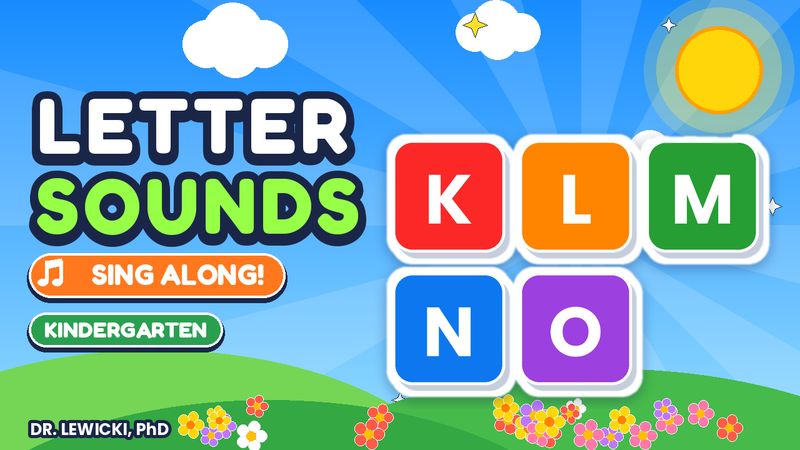
Letter Sounds K to O
 Dr. Lewicki, PhD · On YouTube since Nov 20, 2026
K, L, M, N, O.
Letter Sounds K to O is a two-minute phonics sing-along: the chorus asks what each letter is for and children shout the answers (kite, lion, moon, nest, octopus). Made for kindergarten in the K-2 Sing-Alongs of the Dr. Lewicki, PhD Language Arts Series.
Parts of the song · 6
Lyrics
Tap a line to play the video from there.
Chorus
Verse 1
Chorus
Verse 2
Final Chorus
Outro
Lesson · read it together
Let's learn: letter sounds K to O
Every letter has a sound, and words start with those sounds. Read this part together, say each sound out loud, and tap a pink button to hear that part of the song.
After this lesson, children can
- Name the letters K, L, M, N and O.
- Say the sound each letter makes, as in kite, lion, moon, nest and octopus.
- Hear the first sound in a word and match it to its letter.
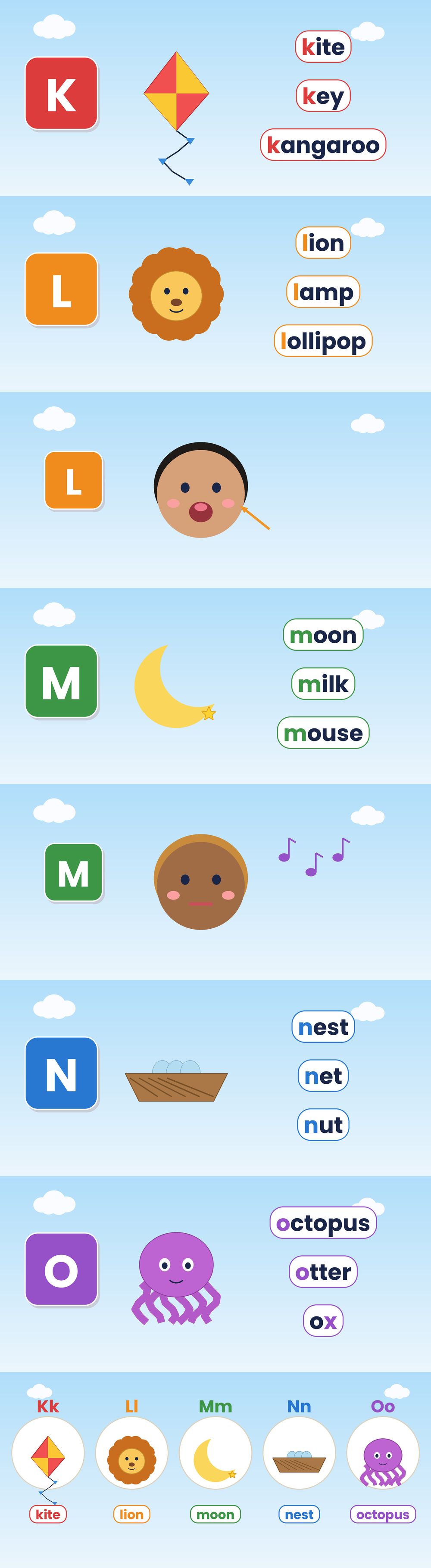
K starts kite and key and a kangaroo kick. 1K: kite, key, kangaroo
K is for kite. Key and kangaroo start with the same sound.
Say it with a little push of air: k, k, k.
L starts lion, lamp and a lollipop lick. 2L: lion, lamp, lollipop
L is for lion, lamp and lollipop.
To make the L sound, lift your tongue up high behind your top teeth: lll.
M starts moon and milk and a mouse so small. 3M: moon, milk, mouse
M is for moon, milk and mouse.
To make the M sound, close your lips and hum: mmm.
N starts nest and net and a nut that falls. 4N: nest, net, nut
N is for nest. Net and nut start with the same sound.
Say them together: nest, net, nut.
O starts octopus, otter and ox. 5O: octopus, otter, ox
O is for octopus, otter and ox.
Now you know five more: K, L, M, N, O!
Key words
- letter
- A mark we use to write words, like K or L.
- sound
- What a letter says, like m in moon.
- beginning sound
- The first sound you hear in a word. Nest begins with n.
- hum
- Make a sound with your lips closed, like mmm.
- word
- A group of sounds that means something, like kite.
Try it: what's the first sound?
Say each word slowly. Tap the letter it starts with.
- keyk-k-key starts like kite.
- lollipopl-l-lollipop: tongue up high.
- mousem-m-mouse: close your lips and hum.
- nutn-n-nut starts like nest.
- octopuso-o-octopus.
- lionl-l-lion starts like lamp.
Quick quiz
Read each question out loud. Children call out the answer, then tap it.
1. M is for?
Show the answer
moon. Moon starts with the M sound.
2. Which word starts like lion?
Show the answer
lamp. Lion and lamp both start with l.
3. For which letter do you close your lips and hum?
Show the answer
M. Close your lips and hum: mmm.
4. Which word starts with N?
Show the answer
nest. n-n-nest.
For grown-ups: teaching this lesson
Time: 15 minutes, kindergarten.
When to use it: the weeks your class learns k, l, m, n or o in UFLI Foundations, Heggerty Bridge to Reading or any other phonics program. (An independent song, not affiliated with those programs.)
- Play the song once all the way through.
- Read the five parts above together. Say each sound slowly and feel your lips and tongue.
- Play it again. Pause before each chorus answer so the class can call it out.
- Do the first-sound game together.
- Hunt the room for things that start with K, L, M, N or O. Exit question: what sound does M make?
Talk about it
- Whose name starts with K, L, M, N or O?
- Can you think of another word that starts like moon? (Mom, map, mitten.)
- What is different about the M sound and the L sound? (M uses closed lips; L uses your tongue.)
Standards and resources
- RF.K.3aDemonstrate basic knowledge of one-to-one letter-sound correspondences by producing the primary sound or many of the most frequent sounds for each consonant.
- RF.K.1dRecognize and name all upper- and lowercase letters of the alphabet.
Teach it next
For teachers
Free to use in class. Play it a few times; it's made to support what students learn in class, not replace it.
About this song
The letters K to O and their sounds, in a two-minute sing-along for kindergarten, with a drawing on screen for every line. The chorus asks what each letter is for and children shout the answers: K is for kite, L is for lion, M is for moon, N is for nest and O is for octopus. The verses add more words for each sound (key and kangaroo, lamp and lollipop, milk and mouse, net and nut, otter and ox) and show how to make the M and L sounds.
How to use it in class Play it once all the way through. Play it again and pause before each answer in the chorus so the class can call it out. On the third play, turn the sound down on the chorus and let them sing it. Fits the weeks your class learns k, l, m, n or o in UFLI Foundations, Heggerty Bridge to Reading or any other phonics program. (An independent song, not affiliated with those programs.)
K-2 Sing-Alongs
Posts this song's page (video, lyrics and quiz) to a class in Google Classroom.
Spot a mistake? Tell us. Every fix is listed on the Corrections page.
Check yourself
What sound does M make? Name a word that starts with it.
Show the answer
M starts moon. More: milk, mouse.
Key terms
- letter sounds
- letter k sound
- letter l sound
- letter m sound
- letter n sound
- letter o sound
- kindergarten phonics
- beginning sounds
- sing along
Lesson pack
Want a free lesson pack for this song?
A lyric sheet with section times, fill-in-the-blank with a word bank, a vocabulary list, a 10-question quiz and exit tickets, all with answer keys. Free for classroom use.
Pick “A lesson pack for one of the songs” on the form and name this song.
Song details
- Subject
- Reading & Writing
- Grades
- Kindergarten
- Length
- 2:04
- Topic
- The letters K to O and words that start with their sounds
- On YouTube
- Nov 20, 2026
- Collection
- K-2 Sing-Alongs
- Music style
- bright acoustic children's folk-pop, the song starts straight on the chorus, ukulele, handclaps, upright bass, glockenspiel, 112 BPM, warm clear female lead on a simple narrow-range melody, a group of children shout each answer after a beat of space, unhurried phrasing, held notes, major key, clear foreground vocals
- Lead vocal
- Female
- Made with
- Music made with Suno AI from lyrics written for this lesson; drawings and video by Dr. Lewicki, PhD