 Plays from YouTube
Sing-along · Science & Nature · Grades 2–3
Life Cycles
 Dr. Lewicki, PhD · On YouTube since Nov 13, 2026
Name every stage, in order.
Cycle It Right is life cycles in one song: what a life cycle is, a flowering plant from seed to seedling to flower, pollination, fruit and new seeds, a monarch butterfly from egg to caterpillar to chrysalis to adult, and a frog from frogspawn to tadpole to froglet to frog, with complete and incomplete metamorphosis for older listeners. Made for grades 2-3 in the Dr. Lewicki, PhD Science Series.
Parts of the song · 13
Lyrics
Tap a line to play the video from there.
Intro
Verse 1
Pre
Chorus
Verse 2
Pre
Chorus
Bridge
Chorus
Outro
Lesson · read it together
Let's learn: life cycles
Plants and animals all have a life cycle: they start small, grow up, make new young, and start again. Read each part together, look at the pictures, and tap a pink button to hear that part of the song.
After this lesson, children can
- Tell what a life cycle is: start, grow up, make new young, start again.
- Name the stages of a plant, a butterfly and a frog.
- Tell what metamorphosis means: a big change, so the young look different from the grown-ups.

A life cycle: it starts, grows up, makes new young, and starts again. 1What is a life cycle?
A life cycle is the stages of a life.
A living thing starts small, grows up and makes new young. Then the young start the cycle again.
A seed sprouts, the plant grows flowers, bees carry pollen, and a fruit grows with seeds inside. 2A plant: from seed to seeds
A plant starts as a seed. Add water and warmth, and it sprouts: the root goes down and the shoot goes up.
The young plant grows into a grown-up plant with flowers. Bees carry pollen from flower to flower.
Part of the flower grows into a fruit with seeds inside. The seeds can grow into new plants.
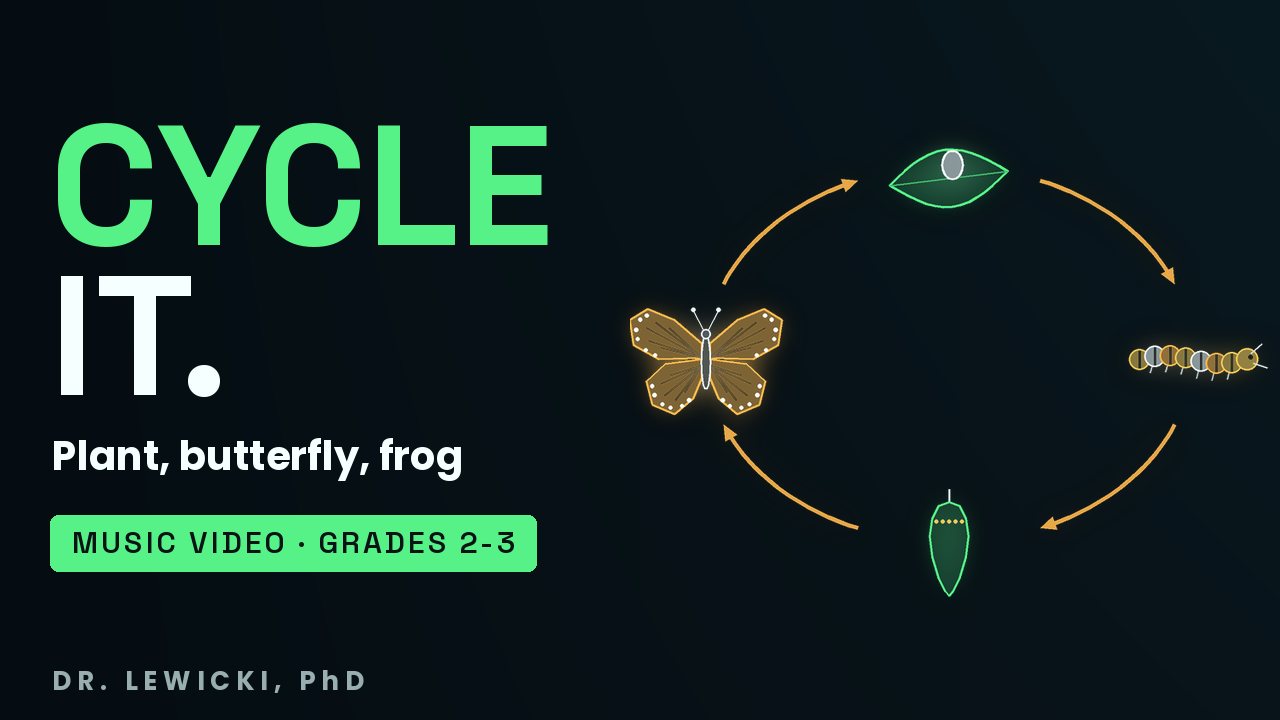
An egg on a milkweed leaf, a caterpillar (larva), a chrysalis (pupa) and a butterfly (adult). 3A butterfly: egg, larva, pupa, adult
A monarch butterfly lays her eggs on milkweed leaves.
A caterpillar, called a larva, hatches. It eats, grows and sheds its skin several times.
Then it becomes a chrysalis, called a pupa. Inside, much of its body is rebuilt.
Out comes the adult butterfly with wings. She lays eggs, and the cycle starts again.
Frogspawn in the pond, a tadpole with a tail and gills, then a froglet as the legs grow and the tail shrinks. 4A frog: eggs, tadpole, froglet, frog
Most frogs start as eggs in the water: a clump of eggs in jelly called frogspawn.
A tadpole hatches. It has a tail to swim and gills to breathe in the water.
Back legs grow first, then front legs, and the tail shrinks away. Now it's a froglet.
A grown-up frog has lungs. It can live on land and in water.
A butterfly has four stages. A grasshopper has three: egg, nymph, adult. 5Big changes: metamorphosis
When the young look very different from the grown-ups, we call the big change metamorphosis.
Butterflies, ladybugs, bees and flies have four stages: egg, larva, pupa, adult.
A grasshopper has three: egg, nymph, adult. A nymph looks like a small grown-up without full wings.
A puppy has no metamorphosis. It looks like its parents, just smaller.
Key words
- life cycle
- The stages of a life: start, grow up, make new young, start again.
- germinate
- When a seed sprouts: the root grows down and the shoot grows up.
- pollination
- Moving pollen from flower to flower, often by bees, so seeds can form.
- larva
- The young stage of an insect like a butterfly. A caterpillar is a larva.
- pupa
- The stage when the body is rebuilt. A butterfly's pupa is a chrysalis.
- tadpole
- A young frog with a tail and gills that lives in water.
- metamorphosis
- A big change in body shape as an animal grows up.
Try it: whose life cycle?
Read each clue and tap plant, butterfly or frog.
- A seed sprouts: root down, shoot up.Seeds germinate and grow into plants.
- A larva eats, grows and sheds its skin.A caterpillar is a butterfly's larva.
- A clump of eggs in jelly in a pond.Frog eggs in jelly are called frogspawn.
- Bees carry pollen from flower to flower.Pollination helps the plant make seeds.
- Back legs first, then front legs, and the tail shrinks.That's a tadpole turning into a froglet.
- A chrysalis hangs still while the body is rebuilt.The chrysalis is the butterfly's pupa.
Quick quiz
Read each question out loud, then tap an answer.
1. What is a life cycle?
Show the answer
The stages of a life, again and again. A life cycle starts, grows up, makes new young and starts again.
2. What hatches from a butterfly egg?
Show the answer
A larva (caterpillar). A caterpillar, the larva, hatches from the egg.
3. What does a tadpole use to breathe in the water?
Show the answer
Gills. Tadpoles breathe with gills. Grown-up frogs have lungs.
4. What grows into a fruit with seeds inside?
Show the answer
Part of the flower. After pollination, part of the flower grows into a fruit.
5. Which animal has no metamorphosis?
Show the answer
A dog. A puppy looks like its parents, just smaller.
For grown-ups: teaching this lesson
Time: 20 to 30 minutes, second and third grade.
- Play the song once all the way through.
- Read the five parts above together. Point to each stage in the pictures.
- Play the chorus again. Pause before each answer so the class can call it out.
- Do the whose-life-cycle game together.
- Draw three circles with arrows: a bean plant, a butterfly and a frog. Exit question: which two of them go through metamorphosis?
Talk about it
- How is a plant's life cycle like an animal's? (Both start small, grow up, make new young and start again.)
- Why do some young animals look so different from their parents? (Metamorphosis: a big change as they grow up.)
- What job do bees do for flowers? (They carry pollen, so the plant can make seeds.)
Standards and resources
- 3-LS1-1Develop models to describe that organisms have unique and diverse life cycles but all have in common birth, growth, reproduction, and death.
- 2-LS2-2Develop a simple model that mimics the function of an animal in dispersing seeds or pollinating plants.
Teach it next
For teachers
Free to use in class. Play it a few times; it's made to support what students learn in class, not replace it.
About this song
A cinematic rock song about life cycles for grades 2-3, written by a PhD scientist, with a drawing on screen for every line. A flowering plant from seed to seedling to flower to fruit to new seeds, a monarch butterfly from egg to caterpillar to chrysalis to adult, and a frog from frogspawn to tadpole to froglet to frog. Older listeners also get complete and incomplete metamorphosis.
Dr. Lewicki Science Series
Posts this song's page (video, lyrics and quiz) to a class in Google Classroom.
Spot a mistake? Tell us. Every fix is listed on the Corrections page.
Check yourself
What are the four stages of a butterfly's life, in order?
Show the answer
Egg, larva (the caterpillar), pupa (the chrysalis), adult (the butterfly). That's complete metamorphosis.
Key terms
- butterfly life cycle
- frog life cycle
- plant life cycle
- metamorphosis
- complete metamorphosis
- incomplete metamorphosis
- egg larva pupa adult
- caterpillar
- chrysalis
- tadpole
- froglet
- germination
- pollination
- seeds
Lesson pack
Want a free lesson pack for this song?
A lyric sheet with section times, fill-in-the-blank with a word bank, a vocabulary list, a 10-question quiz and exit tickets, all with answer keys. Free for classroom use.
Pick “A lesson pack for one of the songs” on the form and name this song.
Song details
- Subject
- Science & Nature
- Grades
- 2–3
- Length
- 5:59
- Topic
- Plants, butterflies, frogs
- On YouTube
- Nov 13, 2026
- Collection
- Dr. Lewicki Science Series
- Music style
- alternative rock, space rock, cinematic strings intro with a single piano note, driving live drums, overdriven guitars, pulsing bass, urgent male and female duet vocals trading verses, both voices together on an anthemic stacked chorus with gang vocals, spoken-word bridge over swelling strings, high-stakes motivational energy, clear foreground vocals
- Lead vocal
- Female
- Made with
- Music made with Suno AI from lyrics written for this lesson; drawings and video by Dr. Lewicki, PhD