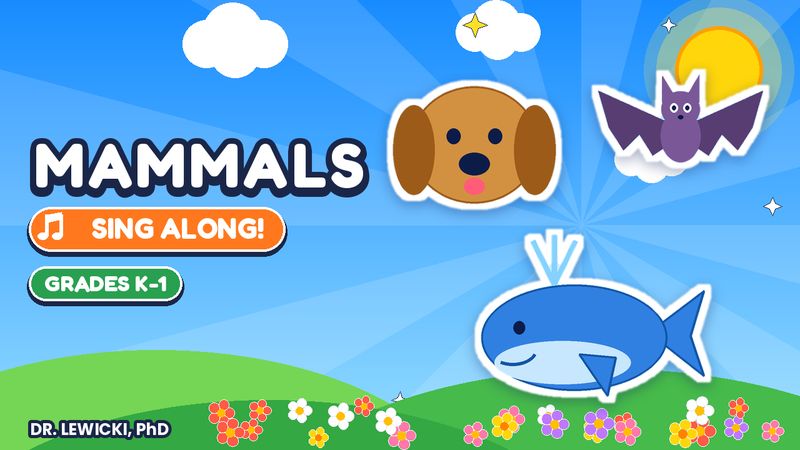
 Plays from YouTube
Sing-along · Science & Nature · Grades K–1
Mammals
 Dr. Lewicki, PhD · On YouTube since Nov 20, 2026
Fur, milk and air: that is a mammal.
Mammals is a two-minute sing-along about what makes an animal a mammal: fur or hair, milk for the babies, and breathing air: the chorus asks and children shout the answers. Made for kindergarten and first grade in the K-2 Sing-Alongs from Dr. Lewicki, PhD.
Parts of the song · 6
Lyrics
Tap a line to play the video from there.
Chorus
Verse 1
Chorus
Verse 2
Final Chorus
Outro
Lesson · read it together
Let's learn: mammals
Mammals have fur or hair, feed their babies milk, and breathe air. And guess what: people are mammals too! Read this part together, point to each mammal, and tap a pink button to hear that part of the song.
After this lesson, children can
- Name three things that make an animal a mammal: fur or hair, milk for babies, breathing air.
- Name mammals that live on land, in the sea and in the air: dog, whale, bat.
- Say that people are mammals too.
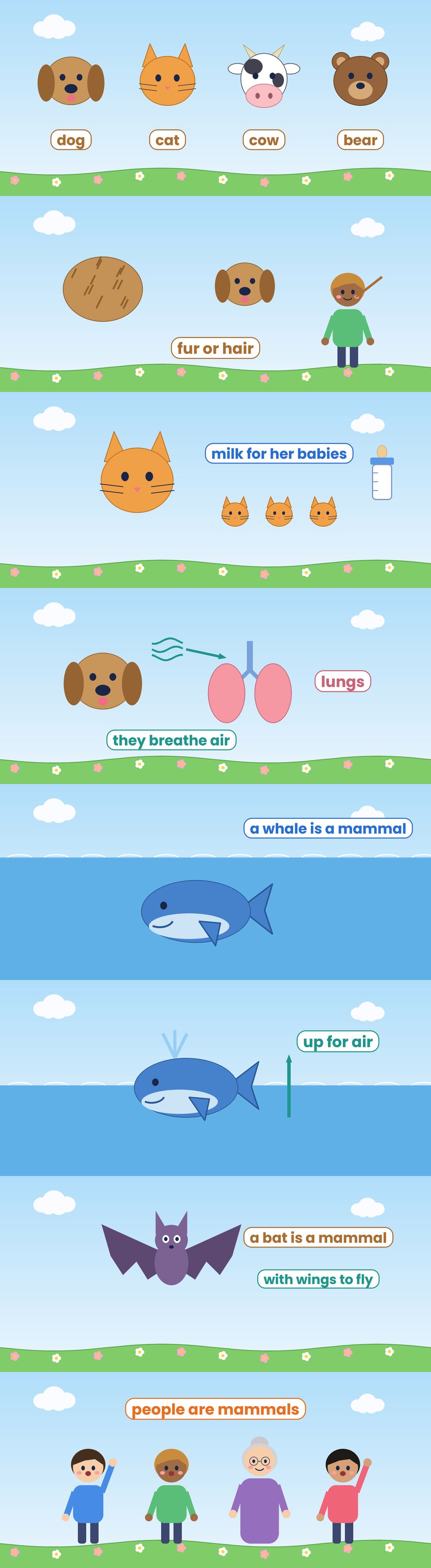
A dog, a cat, a cow and a bear: all of them have fur or hair. 1Fur or hair
Mammals have fur or hair on their skin.
A dog has fur. People have hair.
A mother mammal feeds milk to her young. 2Milk for the babies
Mammal mothers make milk to feed their babies.
Kittens, puppies and calves all drink their mother's milk.
They breathe the air with their lungs. 3They breathe air
Mammals breathe air with lungs.
Fish use gills, but mammals use lungs.
A whale is a mammal that swims in the sea. It comes up for air. 4A whale is a mammal
A whale lives in the sea, but it is not a fish. It's a mammal!
A whale can't breathe underwater. It comes up to breathe air, just like you and me.
A bat is a mammal with wings, and people are mammals: so am I! 5Bats and people too
A bat can fly, but it is not a bird. It has fur, so it's a mammal.
People have hair, drink milk as babies and breathe air. We are mammals too!
Key words
- mammal
- An animal with fur or hair that feeds its babies milk and breathes air.
- fur
- Thick hair on an animal.
- milk
- What mammal mothers feed their babies.
- lungs
- The body parts mammals use to breathe air.
- young
- Babies.
Try it: mammal or not?
Tap Mammal or Not a mammal for each one.
- a dogDogs have fur and drink milk as puppies.
- a whaleWhales breathe air and feed their babies milk.
- a batBats have fur. They're mammals that fly.
- a fishFish have scales and breathe with gills.
- a birdBirds have feathers, not fur.
- you!People are mammals too.
Quick quiz
Read each question out loud. Children call out the answer, then tap it.
1. What grows on a mammal's skin?
Show the answer
Fur or hair. Mammals have fur or hair.
2. What do mammal babies drink?
Show the answer
Milk. Mammal mothers feed their babies milk.
3. Is a whale a fish or a mammal?
Show the answer
A mammal. A whale breathes air and feeds its babies milk.
4. Are you a mammal too?
Show the answer
Yes, I am. People are mammals.
For grown-ups: teaching this lesson
Time: 15 to 20 minutes, kindergarten and first grade.
- Play the song once all the way through.
- Read the five parts above together. Point to each mammal and find its fur or hair.
- Play it again. Pause before each chorus answer so the class can call it out.
- Do the mammal-or-not game together.
- Sort animal pictures into mammals and not mammals. Exit question: name three things all mammals have or do.
Talk about it
- Why isn't a whale a fish? (It breathes air with lungs and feeds its babies milk.)
- Is a bat a bird? (No. It has fur, so it's a mammal.)
- Which pets at home are mammals?
Standards and resources
- 1-LS1-2Read texts and use media to determine patterns in behavior of parents and offspring that help offspring survive.
Teach it next
For teachers
Free to use in class. Play it a few times; it's made to support what students learn in class, not replace it.
About this song
Mammals is a two-minute sing-along for kindergarten and first grade about what makes an animal a mammal: fur or hair, milk for the babies, and breathing air, with a drawing on screen for every line. The chorus asks and children shout the answers: What grows on a mammal's skin? Fur or hair! What do mammal babies drink? Milk! What do mammals breathe? Air! Are you a mammal too? Yes, I am! The verses show a dog, a cat, a cow and a bear with fur or hair, a mother feeding milk to her young, a whale coming up for air, a bat that flies, and people, who are mammals too.
How to use it in class Play it once all the way through. Play it again and pause before each answer in the chorus so the class can call it out. On the third play, turn the sound down on the chorus and let them sing it.
K-2 Sing-Alongs
Posts this song's page (video, lyrics and quiz) to a class in Google Classroom.
Spot a mistake? Tell us. Every fix is listed on the Corrections page.
Check yourself
What do mammal babies drink? Is a whale a mammal?
Show the answer
Milk. Yes: it breathes air.
Key terms
- what is a mammal
- whale is a mammal
- bat is a mammal
- kindergarten science
- sing along
Lesson pack
Want a free lesson pack for this song?
A lyric sheet with section times, fill-in-the-blank with a word bank, a vocabulary list, a 10-question quiz and exit tickets, all with answer keys. Free for classroom use.
Pick “A lesson pack for one of the songs” on the form and name this song.
Song details
- Subject
- Science & Nature
- Grades
- K–1
- Length
- 2:05
- Topic
- What makes an animal a mammal: fur or hair, mothers feed their babies milk, they breathe air with lungs; dogs, whales, bats and people are all mammals
- On YouTube
- Nov 20, 2026
- Collection
- K-2 Sing-Alongs
- Music style
- Bright acoustic children's folk-pop, 112 BPM major-key bounce with unhurried phrasing and held notes; warm clear female lead sings a simple narrow-range melody in dry, up-front half-spoken talk-sing, while children shout each answer after a beat of space; clear foreground vocals, chorus starts right away; strummed ukulele, handclaps, plucked upright bass and glockenspiel chimes carry the verses into a full-group final chorus and children-led outro.
- Lead vocal
- Female
- Made with
- Music made with Suno AI from lyrics written for this lesson; drawings and video by Dr. Lewicki, PhD