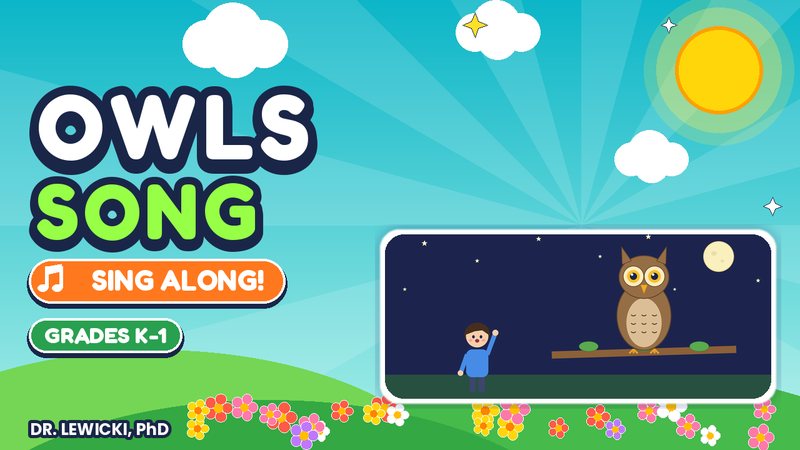
 Plays from Google Drive
Sing-along · Science & Nature · Grades K–1
Owls
 Dr. Lewicki, PhD · Premieres on YouTube Dec 20, 2026 · plays here now
Owls hunt at night with big eyes, turning heads, sharp ears, silent wings and talons. Lyrics, lesson and quiz: https://drlewicki.com/songs/owls/
Owls is a two-minute sing-along about owls: owls hunt at night with big eyes, turn their heads because their eyes cannot move, hear tiny sounds, fly silently on soft feathers, grab food with talons and hoot. The chorus asks and children shout the answers. Made for kindergarten and first grade in the K-2 Sing-Alongs from Dr. Lewicki, PhD.
Parts of the song · 6
Lyrics
Press play on the video and sing along with the words below.
Chorus
Verse 1
Chorus
Verse 2
Final Chorus
Outro
Lesson · read it together
Let's learn: owls
Most owls hunt at night. Big eyes help them see in the dark, but their eyes can't move, so owls turn their heads, even to look behind. Sharp ears hear a mouse, soft feathers make them silent, talons grab food, and they hoot. Read this part together, turn your head like an owl without moving your eyes.
After this lesson, children can
- Tell that most owls hunt at night.
- Describe how big eyes, turning heads and sharp ears help owls.
- Tell how soft feathers and talons help owls catch food.
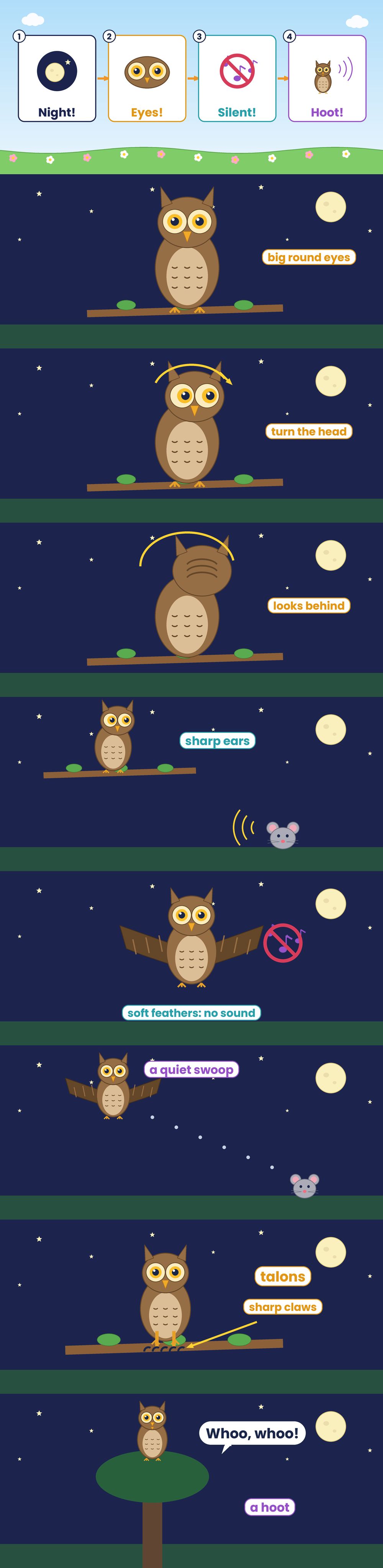
Night, eyes, silent, hoot. 1Who's up in the tree?
Whoo, whoo, who's up in the tree?
Owls are amazing, wait and see!
Big eyes, turning head. 2Big eyes
Owls have big round eyes to see in the dark of night.
Their eyes can't roll around, so they turn their heads.
Looks behind. Hears a mouse. 3Look and listen
An owl can turn its head to look behind its back.
Its ears can hear a mouse that rustles on the track.
Soft feathers, no sound. 4Silent wings
Soft, fluffy feathers let an owl fly with no sound,
Swooping down so quietly to the ground.
Talons, then a hoot. 5Talons and a hoot
With sharp claws called talons, it grabs its food to eat.
Then it hoots from the treetop: whoo, whoo!
Key words
- owl
- A bird with big eyes that mostly hunts at night.
- talons
- The sharp claws on an owl's feet.
- silent
- Making no sound at all.
- hoot
- The sound an owl makes: whoo, whoo!
- night
- The dark time when owls hunt.
Try it: how does it help?
Listen to each owl part. Does it help the owl see, hear or grab?
- Big round eyes.Big eyes help owls see in the dark.
- Sharp ears.Owls can hear a mouse rustle.
- Sharp talons.Talons grab food.
- A head that turns far around.Turning the head helps owls look behind.
- Listening for a tiny rustle.Sharp hearing finds food in the dark.
Quick quiz
Read each question out loud. Children call out the answer, then tap it.
1. When do owls hunt?
Show the answer
at night. Most owls hunt at night.
2. Why do owls turn their heads?
Show the answer
their eyes can't move. Owl eyes can't roll around.
3. Soft feathers make owls?
Show the answer
silent. They fly with no sound.
4. An owl's sharp claws are called?
Show the answer
talons. They are talons.
For grown-ups: teaching this lesson
Time: 15 minutes, kindergarten and grade 1.
- Play the song once all the way through.
- Read the five parts above together. Have children look at one spot, then turn only their heads to see behind them, like an owl.
- Play it again. Pause before each chorus answer so the class can call it out.
- Do the how does it help game together.
- Children draw an owl and label its big eyes, ears, soft feathers and talons. Then they flap their arms and try to fly as quietly as an owl. Exit question: why do owls turn their heads?
Talk about it
- Why do owls need to be quiet when they fly?
- What other animals come out at night?
- How are owls and bats alike? How are they different?
Standards and resources
- 1-LS1-1Use materials to design a solution to a human problem by mimicking how plants and/or animals use their external parts to help them survive, grow, and meet their needs.
- K-LS1-1Use observations to describe patterns of what plants and animals (including humans) need to survive.
Teach it next
For teachers
Free to use in class. Play it a few times; it's made to support what students learn in class, not replace it.
About this song
Owls is a two-minute sing-along for kindergarten and first grade about owls: owls hunt at night with big eyes, turn their heads because their eyes cannot move, hear tiny sounds, fly silently on soft feathers, grab food with talons and hoot, with a drawing on screen for every line. The chorus asks and children shout the answers: When do owls hunt? At? Night! What helps owls see in the dark? Big? Eyes! Owls fly with no sound, so they're? Silent! What sound does an owl make? A? Hoot! The verses show an owl on a branch under the moon with big round eyes, the owl turning its head and looking right behind its back, listening for a mouse, flying with wide soft wings, a quiet swoop, sharp talons on a branch, and hooting from a treetop.
How to use it in class Play it once all the way through. Play it again and pause before each answer in the chorus so the class can call it out. On the third play, turn the sound down on the chorus and let them sing it.
K-2 Sing-Alongs
Posts this song's page (video, lyrics and quiz) to a class in Google Classroom.
Spot a mistake? Tell us. Every fix is listed on the Corrections page.
Check yourself
Why does an owl turn its head? What are an owl's sharp claws called?
Show the answer
Its eyes can't move. Talons.
Key terms
- why do owls turn their heads
- sing along
Lesson pack
Want a free lesson pack for this song?
A lyric sheet with section times, fill-in-the-blank with a word bank, a vocabulary list, a 10-question quiz and exit tickets, all with answer keys. Free for classroom use.
Pick “A lesson pack for one of the songs” on the form and name this song.
Song details
- Subject
- Science & Nature
- Grades
- K–1
- Length
- 2:02
- Topic
- Owls: owls hunt at night; big eyes help them see in the dark, and because their eyes cannot move around, they turn their heads far to look behind them; sharp hearing finds mice, soft feathers let them fly silently, talons grab food, and they hoot
- On YouTube
- Premieres Dec 20, 2026
- Collection
- K-2 Sing-Alongs
- Made with
- Music made with Suno AI from lyrics written for this lesson; drawings and video by Dr. Lewicki, PhD