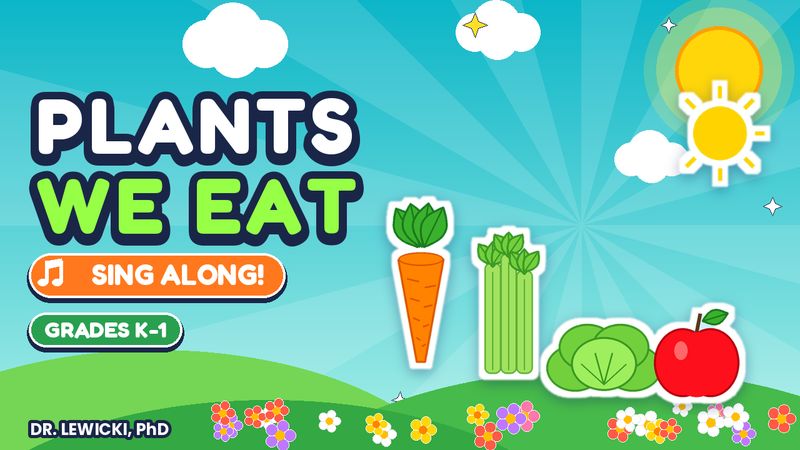
 Plays from YouTube
Sing-along · Science & Nature · Grades K–1
Plants We Eat
 Dr. Lewicki, PhD · On YouTube since Nov 17, 2026
Root, stem, leaf, fruit.
Plants We Eat is a two-minute sing-along about the parts of plants we eat: the chorus asks four questions and children shout the answers (root, stem, leaf, fruit). Made for grades K-1 in the K-2 Sing-Alongs of the Dr. Lewicki, PhD Science Series.
Parts of the song · 6
Lyrics
Tap a line to play the video from there.
Chorus
Verse 1
Chorus
Verse 2
Final Chorus
Outro
Lesson · read it together
Let's learn: the plant parts we eat
We eat roots, stems, leaves and fruits of plants every day. Read this part together, point to each part of the plant, and tap a pink button to hear that part of the song.
After this lesson, children can
- Name four plant parts we eat: root, stem, leaf and fruit.
- Give one food for each part: carrot, celery, lettuce, apple.
- Say one job of each part: roots drink water, stems carry it, leaves catch sunlight, fruits hold seeds.
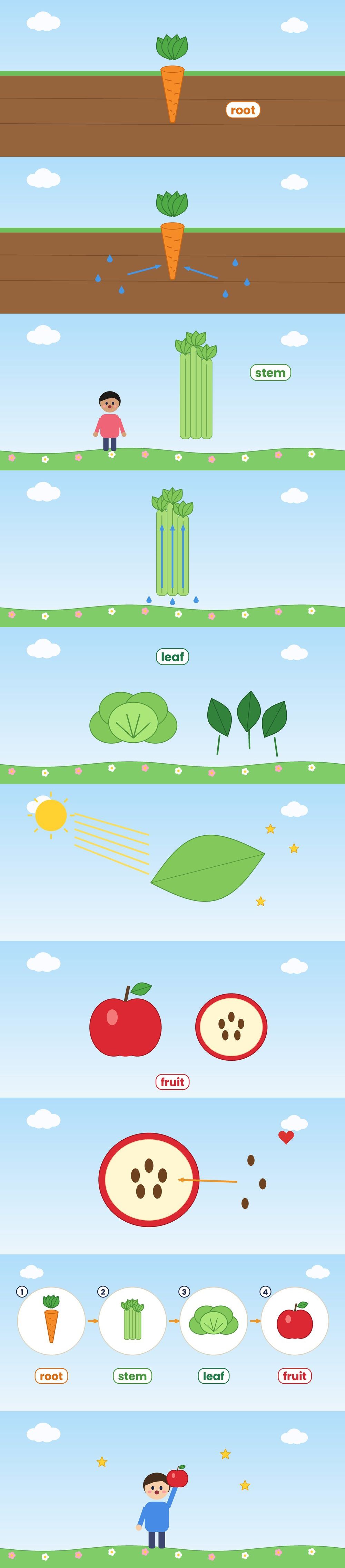
A carrot is a root. It drinks up water from the ground. 1Roots: a carrot
A carrot grows down in the dark, cool ground. The part we eat is the root.
Roots drink up water from the soil for the plant.
Celery is a stem. It carries the water up. 2Stems: celery
Celery stands tall. The crunchy part we eat is the stem.
Stems carry water up from the roots to the rest of the plant.
Lettuce and spinach are leaves. They catch sunlight. 3Leaves: lettuce and spinach
When we eat lettuce or spinach, we are eating leaves.
Leaves catch sunlight and use it to make food for the plant.
An apple is a fruit. A fruit holds the seeds. 4Fruits: an apple
An apple is a fruit. Cut it open and you find seeds inside.
That's the clue: if it holds the seeds, it's a fruit.
Root. Stem. Leaf. Fruit. Yum! 5Root, stem, leaf, fruit
We eat the parts of plants every day.
Next time you eat, ask: is it a root, a stem, a leaf or a fruit?
Key words
- root
- The part of a plant that grows under the ground and drinks up water. A carrot is a root.
- stem
- The part that holds the plant up and carries water. Celery is a stem.
- leaf
- The flat, green part that catches sunlight. Lettuce is a leaf.
- fruit
- The part of a plant that holds the seeds. An apple is a fruit.
- seed
- The tiny part inside a fruit that can grow into a new plant.
Try it: which part do we eat?
Tap Root, Stem, Leaf or Fruit for each food.
- a carrotA carrot grows down in the ground and drinks up water.
- a celery stalkCelery is a stem. It carries water up the plant.
- lettuceLettuce leaves catch sunlight to make food.
- an appleAn apple holds the seeds, so it's a fruit.
- a sweet potatoA sweet potato grows under the ground. It's a root.
- a cucumberLook inside: seeds! A cucumber is a fruit.
Quick quiz
Read each question out loud. Children call out the answer, then tap it.
1. Is a carrot a root?
Show the answer
Yes, a root. A carrot grows under the ground. It's a root.
2. Celery is a...?
Show the answer
stem. Celery is a stem. It carries water up.
3. Which part holds the seeds?
Show the answer
the fruit. A fruit holds the seeds, like an apple.
4. What do leaves catch?
Show the answer
sunlight. Leaves catch sunlight to make food for the plant.
For grown-ups: teaching this lesson
Time: 15 to 20 minutes, kindergarten and first grade.
- Play the song once all the way through.
- Read the five parts above together. Point to the root, stem, leaf and fruit in each picture.
- Play it again. Pause before each chorus answer so the class can call it out.
- Do the which-part sort together.
- If you can, bring a real carrot, celery, lettuce and apple (or pictures) and sort them on a table. Exit question: which part holds the seeds?
Talk about it
- What did you eat today? Was it a root, a stem, a leaf or a fruit?
- Why is a tomato a fruit? (It holds seeds inside.)
- What would happen to a plant with no roots? (It could not drink water.)
Standards and resources
- 1-LS1-1Use materials to design a solution to a human problem by mimicking how plants and/or animals use their external parts to help them survive, grow, and meet their needs.
- K-LS1-1Use observations to describe patterns of what plants and animals (including humans) need to survive.
Teach it next
For teachers
Free to use in class. Play it a few times; it's made to support what students learn in class, not replace it.
About this song
The parts of plants we eat, in a two-minute sing-along for kindergarten and first grade, written by a PhD scientist, with a drawing on screen for every line. The chorus asks four questions and children shout the answers: a carrot is a root, celery is a stem, lettuce is a leaf, and an apple is a fruit. Verse 1 shows the carrot drinking water underground and the celery carrying it up, and verse 2 shows leaves catching sunlight and the seeds inside a fruit.
How to use it in class Play it once all the way through. Play it again and pause before each answer in the chorus so the class can call it out. On the third play, turn the sound down on the chorus and let them sing it.
K-2 Sing-Alongs
Posts this song's page (video, lyrics and quiz) to a class in Google Classroom.
Spot a mistake? Tell us. Every fix is listed on the Corrections page.
Check yourself
Which part of the plant is celery?
Show the answer
A stem. It carries water up the plant.
Key terms
- parts of a plant we eat
- root stem leaf fruit
- kindergarten science
- sing along
Lesson pack
Want a free lesson pack for this song?
A lyric sheet with section times, fill-in-the-blank with a word bank, a vocabulary list, a 10-question quiz and exit tickets, all with answer keys. Free for classroom use.
Pick “A lesson pack for one of the songs” on the form and name this song.
Song details
- Subject
- Science & Nature
- Grades
- K–1
- Length
- 2:05
- Topic
- We eat roots, stems, leaves and fruits of plants
- On YouTube
- Nov 17, 2026
- Collection
- K-2 Sing-Alongs
- Music style
- bright acoustic children's folk-pop, the song starts straight on the chorus, ukulele, handclaps, upright bass, glockenspiel, 112 BPM, warm clear female lead on a simple narrow-range melody, a group of children shout each answer after a beat of space, unhurried phrasing, held notes, major key, clear foreground vocals
- Lead vocal
- Female
- Made with
- Music made with Suno AI from lyrics written for this lesson; drawings and video by Dr. Lewicki, PhD