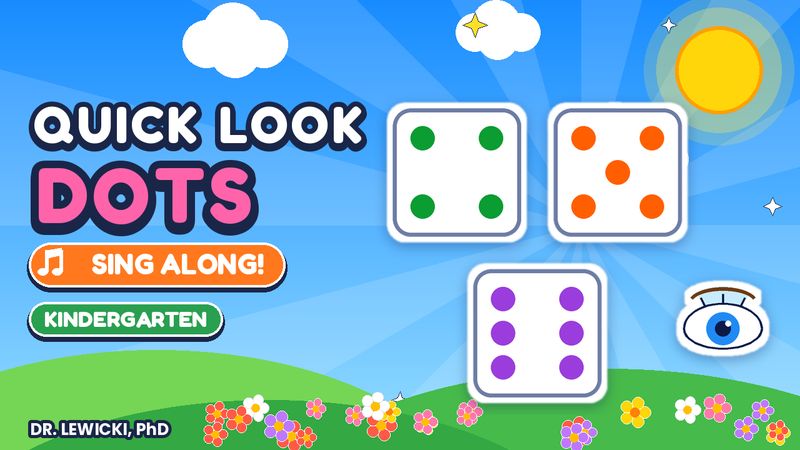
 Plays from YouTube
Sing-along · Math & Counting · Kindergarten
Quick Look Dots
 Dr. Lewicki, PhD · On YouTube since Nov 21, 2026
Quick look: how many? I just see it!
Quick Look Dots is a two-minute sing-along about seeing how many dots there are without counting them one by one (subitizing): the chorus asks and children shout the answers. Made for kindergarten in the K-2 Sing-Alongs from Dr. Lewicki, PhD.
Parts of the song · 6
Lyrics
Tap a line to play the video from there.
Chorus
Verse 1
Chorus
Verse 2
Final Chorus
Outro
Lesson · read it together
Let's learn: quick look dots
With a quick look, you can see how many dots there are without counting them one by one. Read this part together, look at each picture for just a blink, then say how many, and tap a pink button to hear that part of the song.
After this lesson, children can
- See small groups (2 or 3) without counting.
- Know dice patterns at a glance: four corners, five with one in the middle, six as two rows of three.
- Use five as a helper: a hand, a full row on a ten frame.
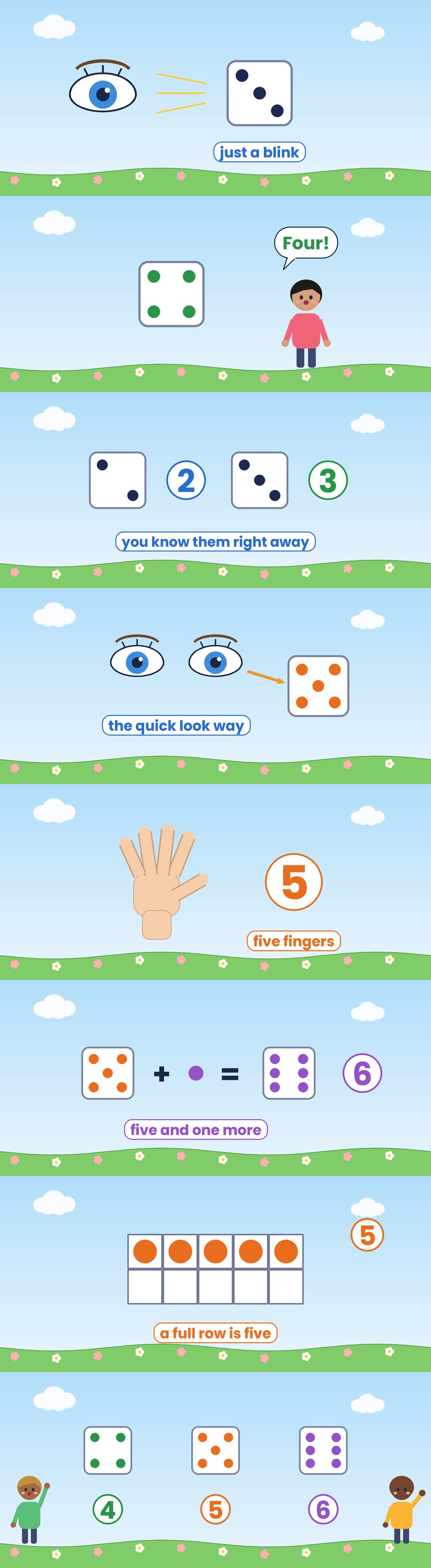
Look at the dots for just a blink. You can tell how many faster than you think. 1Just a blink
Some numbers we can see in a blink, without counting.
Four dots in the corners? Four! That's a quick look.
Two dots, three dots, you know them right away. 2Two and three right away
Small groups, like two or three, are easy to see right away.
Your eyes can see it: that's the quick look way.
Five is a hand, five fingers up high. 3Five is a hand
Hold up a hand: that's five, and you don't have to count.
Five is a great helper number.
Five and one more is six, I don't have to try. 4Five and one more is six
Five dots and one more make six.
Six on a die is two rows of three.
A full row of five on a ten frame. Quick look at the dots, and you'll know! 5A full row is five
On a ten frame, a full row is five.
Four corners is four, add one in the middle for five, and two rows of three is six.
Key words
- quick look
- Seeing how many in a blink, without counting.
- dots
- Small round marks, like on a die.
- pattern
- A shape the dots make, like four corners.
- ten frame
- A box with two rows of five spaces.
- how many
- The number of things in all.
Try it: quick look!
Read each picture or clue and tap how many. Try not to count!
- One dot in each corner.Four corners make four.
- Four corners and one in the middle.Five, like on a die.
- Two rows of three.Three and three make six.
- Five fingers up high.A hand is five.
- Quick look: how many?You can see three without counting.
- Quick look: how many?Two, right away.
Quick quiz
Read each question out loud. Children call out the answer, then tap it.
1. One dot in each corner?
Show the answer
Four. Four corners, four dots.
2. Four corners and one in the middle?
Show the answer
Five. That's the five pattern on a die.
3. Two rows of three?
Show the answer
Six. 3 and 3 make 6.
4. How many fingers on one hand?
Show the answer
5. One hand is five.
For grown-ups: teaching this lesson
Time: 15 minutes, kindergarten.
- Play the song once all the way through.
- Read the five parts above together. Show each picture for a blink, then ask how many.
- Play it again. Pause before each chorus answer so the class can call it out.
- Do the quick-look game together.
- Flash dot cards or dice for 2 seconds and have children call out how many. Exit question: what does five look like on a die?
Talk about it
- How did you know it was six without counting? (Two rows of three.)
- Where else do we see quick-look patterns? (Dice, dominoes, fingers.)
- What helper number is a hand? (Five.)
Standards and resources
- K.CC.B.5 (supports)Count to answer "how many?" questions about as many as 20 things arranged in a line, a rectangular array, or a circle, or as many as 10 things in a scattered configuration; given a number from 1-20, count out that many objects.
Teach it next
For teachers
Free to use in class. Play it a few times; it's made to support what students learn in class, not replace it.
About this song
Quick Look Dots is a two-minute sing-along for kindergarten about seeing how many dots there are without counting them one by one (subitizing), with a drawing on screen for every line. The chorus asks and children shout the answers: Dice dots, no counting? I just see it! One dot in each corner? Four! Four corners and one in the middle? Five! Two rows of three? Six! The verses show small groups of two and three, five as a hand of fingers, six as five and one more, and a full row of five on a ten frame.
How to use it in class Play it once all the way through. Play it again and pause before each answer in the chorus so the class can call it out. On the third play, turn the sound down on the chorus and let them sing it.
K-2 Sing-Alongs
Posts this song's page (video, lyrics and quiz) to a class in Google Classroom.
Spot a mistake? Tell us. Every fix is listed on the Corrections page.
Check yourself
How many is one dot in each corner? Two rows of three?
Show the answer
Four. Six.
Key terms
- dot cards
- dice dots
- how many dots
- kindergarten math
- sing along
Lesson pack
Want a free lesson pack for this song?
A lyric sheet with section times, fill-in-the-blank with a word bank, a vocabulary list, a 10-question quiz and exit tickets, all with answer keys. Free for classroom use.
Pick “A lesson pack for one of the songs” on the form and name this song.
Song details
- Subject
- Math & Counting
- Grades
- Kindergarten
- Length
- 2:05
- Topic
- Subitizing: seeing how many dots at a glance without counting (dice patterns: four corners, five with one in the middle, six as two rows of three; five fingers is a hand)
- On YouTube
- Nov 21, 2026
- Collection
- K-2 Sing-Alongs
- Music style
- Bright acoustic children's folk-pop, 112 BPM major-key bounce with unhurried phrasing and held notes; warm clear female lead sings a simple narrow-range melody in dry, up-front half-spoken talk-sing, while children shout each answer after a beat of space; clear foreground vocals, chorus starts right away; strummed ukulele, handclaps, plucked upright bass and glockenspiel chimes carry the verses into a full-group final chorus and children-led outro.
- Lead vocal
- Female
- Made with
- Music made with Suno AI from lyrics written for this lesson; drawings and video by Dr. Lewicki, PhD