 Plays from Google Drive
Sing-along · Science & Nature · Grades 1–2
Water Cycle
 Dr. Lewicki, PhD · Premieres on YouTube Dec 18, 2026 · plays here now
Evaporate, condense, rain, collect: round and round the water goes. Lyrics, lesson and quiz: https://drlewicki.com/songs/water-cycle/
Water Cycle is a two-minute sing-along about the water cycle: the sun warms water so it evaporates into vapor, the vapor rises, cools and condenses into clouds, the drops fall as rain or snow, and the water collects in lakes and the sea. The chorus asks and children shout the answers. Made for first and second grade in the K-2 Sing-Alongs from Dr. Lewicki, PhD.
Parts of the song · 6
Lyrics
Press play on the video and sing along with the words below.
Chorus
Verse 1
Chorus
Verse 2
Final Chorus
Outro
Lesson · read it together
Let's learn: the water cycle
Water goes around and around: the sun makes it evaporate, it condenses into clouds, it falls as rain or snow, and it collects in lakes and the sea. Read this part together, move your hands up for evaporate and down for rain.
After this lesson, children can
- Name the steps of the water cycle: evaporate, condense, rain, collect.
- Tell that the sun heats water and turns it into vapor.
- Tell that water falls as rain or snow and collects in lakes and oceans.
Evaporate, condense, rain, collect. 1Round and round
Water on Earth goes around and around.
This is called the water cycle.
Water turns to vapor. 2The sun heats water
The sun shines down on the lake and the sea.
Water turns to vapor you cannot see.
It cools: condense. 3Up into clouds
The vapor floats up, way up in the sky.
It cools into clouds.
Down they fall. 4Rain and snow
The drops get heavy, so down they fall.
They fall as rain or snow on the mountains.
Again and again. 5Collect and start again
The water collects in lakes and the sea.
Then the cycle starts again.
Key words
- evaporate
- When water warms up and turns into vapor.
- vapor
- Water as a gas, which we cannot see.
- condense
- When vapor cools and turns back into tiny drops, making clouds.
- collect
- To gather together in one place.
- cycle
- Something that happens again and again, in a circle.
Try it: going up or coming down?
Listen to each step. Is the water going up into the sky or coming down?
- The sun warms a puddle and the water evaporates.Evaporating water rises as vapor.
- Heavy drops fall from a cloud.Rain comes down.
- Vapor floats higher and higher.Vapor goes up.
- Snow falls on a mountain.Snow comes down.
- Steam rises from a hot pot.Steam is vapor going up.
Quick quiz
Read each question out loud. Children call out the answer, then tap it.
1. When the sun heats water, it will?
Show the answer
evaporate. It evaporates.
2. When the vapor cools into clouds, it will?
Show the answer
condense. It condenses.
3. When the drops get heavy, down comes the?
Show the answer
rain. Down comes the rain.
4. In lakes and oceans, water will?
Show the answer
collect. It collects.
For grown-ups: teaching this lesson
Time: 15 to 20 minutes, grades 1 and 2.
- Play the song once all the way through.
- Read the five parts above together. Have children raise their hands for evaporate, make a cloud for condense, wiggle fingers down for rain and cup their hands for collect.
- Play it again. Pause before each chorus answer so the class can call it out.
- Do the up or down game together.
- Water cycle in a bag: put a little water in a zip bag, seal it, tape it to a sunny window and draw what you see after a few hours (drops on the plastic, water at the bottom). Exit question: what does the sun do to water?
Talk about it
- Where does a puddle go on a sunny day?
- Why does it rain?
- Where have you seen water collect?
Standards and resources
- 2-ESS2-3Obtain information to identify where water is found on Earth and that it can be solid or liquid.
- 2-PS1-4Construct an argument with evidence that some changes caused by heating or cooling can be reversed and some cannot.
Teach it next
For teachers
Free to use in class. Play it a few times; it's made to support what students learn in class, not replace it.
About this song
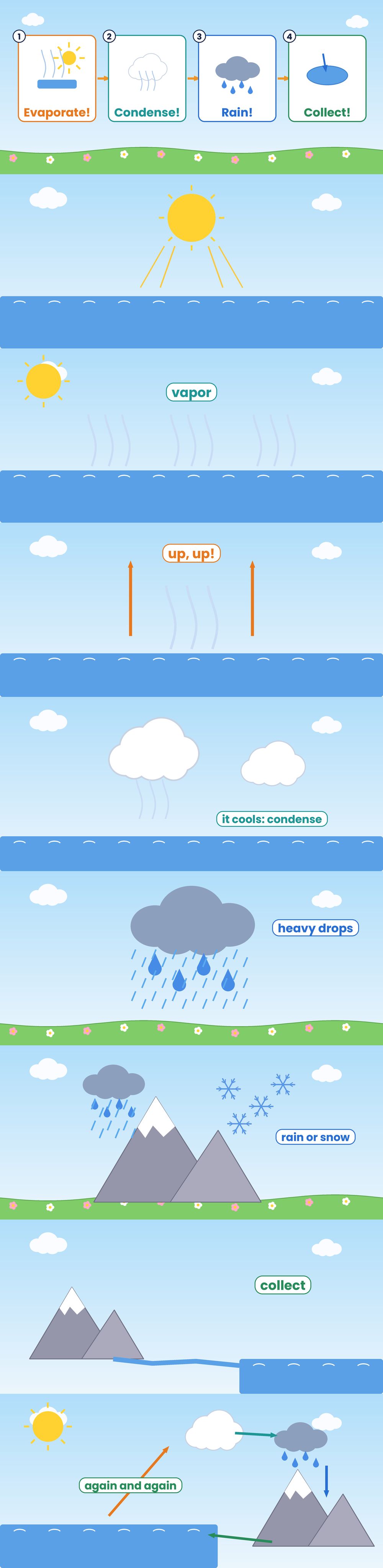
Water Cycle is a two-minute sing-along for first and second grade about the water cycle: the sun warms water so it evaporates into vapor, the vapor rises, cools and condenses into clouds, the drops fall as rain or snow, and the water collects in lakes and the sea, with a drawing on screen for every line. The chorus asks and children shout the answers: When the sun heats water, it will? Evaporate! When the vapor cools into clouds, it will? Condense! When the drops get heavy, down comes the? Rain! In lakes and oceans, water will? Collect! The verses show the sun shining on the sea, invisible vapor rising, arrows going up into the sky, clouds forming as the vapor cools, heavy raindrops falling, rain and snow on the mountains, a river flowing to the sea, and the whole cycle with arrows.
How to use it in class Play it once all the way through. Play it again and pause before each answer in the chorus so the class can call it out. On the third play, turn the sound down on the chorus and let them sing it.
K-2 Sing-Alongs
Posts this song's page (video, lyrics and quiz) to a class in Google Classroom.
Spot a mistake? Tell us. Every fix is listed on the Corrections page.
Check yourself
What does water do when the sun heats it? Where does the water collect?
Show the answer
Evaporate. Lakes and oceans.
Key terms
- evaporation condensation precipitation
- rain cycle
- sing along
Lesson pack
Want a free lesson pack for this song?
A lyric sheet with section times, fill-in-the-blank with a word bank, a vocabulary list, a 10-question quiz and exit tickets, all with answer keys. Free for classroom use.
Pick “A lesson pack for one of the songs” on the form and name this song.
Song details
- Subject
- Science & Nature
- Grades
- 1–2
- Length
- 2:05
- Topic
- The water cycle: the sun warms water so it evaporates into vapor, the vapor cools and condenses into clouds, the drops fall as rain or snow, and the water collects in lakes and oceans
- On YouTube
- Premieres Dec 18, 2026
- Collection
- K-2 Sing-Alongs
- Made with
- Music made with Suno AI from lyrics written for this lesson; drawings and video by Dr. Lewicki, PhD