 Plays from Google Drive
Sing-along · Science & Nature · Grades K–2
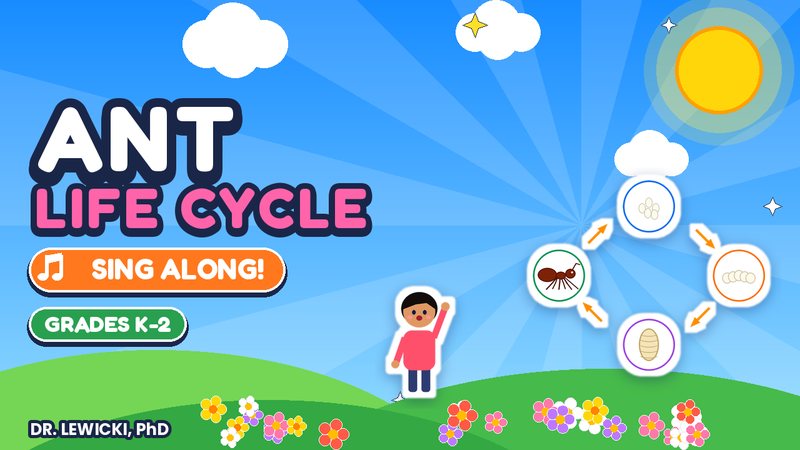
Ant Life Cycle
 Dr. Lewicki, PhD · Premieres on YouTube Dec 16, 2026 · plays here now
Egg, larva, pupa, ant: the queen lays eggs and worker ants care for the young. Lyrics, lesson and quiz: https://drlewicki.com/songs/ant-life-cycle/
Ant Life Cycle is a two-minute sing-along about the ant life cycle: the queen lays tiny eggs, the eggs hatch into legless larvae that worker ants feed, the larva rests as a pupa, and an adult ant with six legs comes out. The chorus asks and children shout the answers. Made for kindergarten to second grade in the K-2 Sing-Alongs from Dr. Lewicki, PhD.
Parts of the song · 6
Lyrics
Press play on the video and sing along with the words below.
Chorus
Verse 1
Chorus
Verse 2
Final Chorus
Outro
Lesson · read it together
Let's learn: the ant life cycle
Ants grow in four stages: the queen lays eggs, eggs hatch into larvae, larvae become pupae, and adult ants come out. Read this part together, trace the four stages with your finger.
After this lesson, children can
- Name the four stages of the ant life cycle: egg, larva, pupa, ant.
- Tell that the queen lays the eggs and worker ants feed the larvae.
- Tell that an adult ant has six legs and helps the colony.
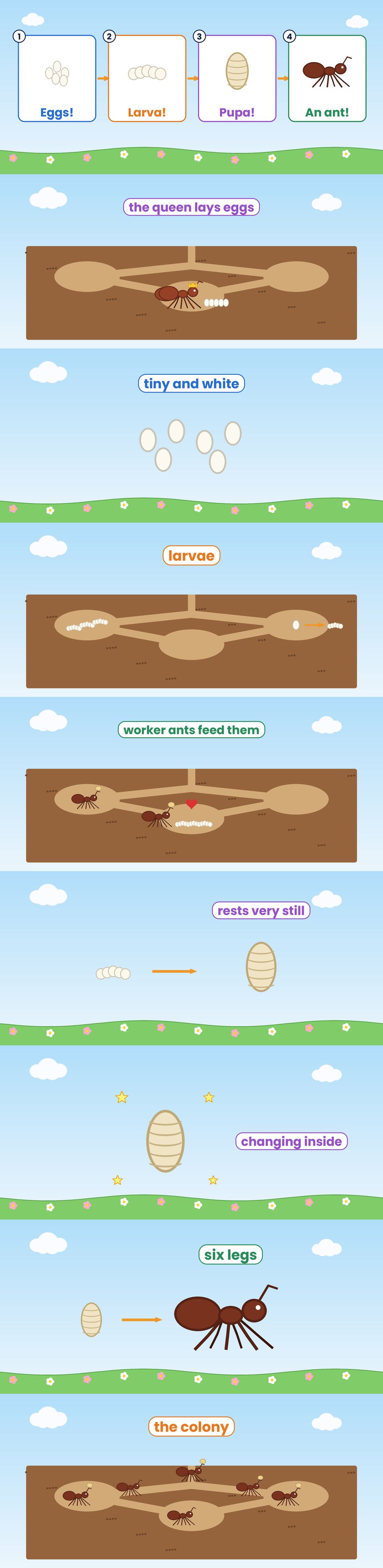
Egg, larva, pupa, ant. 1Watch them grow
Ants grow up in a nest under the ground.
They change in four stages.
The queen lays eggs. 2The queen and her eggs
Deep in the nest, the queen lays eggs.
The eggs are tiny and white, with no legs.
Workers feed them. 3Hungry larvae
The eggs hatch into larvae, hungry and small.
Worker ants feed them and take care of them all.
Still, but changing. 4The pupa
The larva grows big, then rests very still.
It is a pupa, changing inside.
Six legs, hooray! 5Out comes an ant
Out comes an ant with six legs.
It helps the colony every day.
Key words
- life cycle
- The stages an animal goes through as it grows.
- queen
- The ant that lays the eggs.
- larva
- The baby stage with no legs; worker ants feed it.
- pupa
- The resting stage when the body changes.
- colony
- A big family of ants living and working together.
Try it: which stage?
Listen to each clue. Is it the larva or the pupa?
- Worker ants feed it.Workers feed the hungry larva.
- It rests very still.The pupa rests while it changes.
- It is wiggly and has no legs.The larva has no legs.
- Its body is changing inside.The pupa changes inside.
- It eats and grows bigger.The larva eats and grows.
Quick quiz
Read each question out loud. Children call out the answer, then tap it.
1. What does the queen ant lay?
Show the answer
eggs. The queen lays the eggs.
2. The wiggly baby with no legs is a?
Show the answer
larva. The baby ant is a larva.
3. When it rests and changes, it is a?
Show the answer
pupa. The resting stage is the pupa.
4. What comes out at the end?
Show the answer
an ant. An adult ant comes out.
For grown-ups: teaching this lesson
Time: 15 to 20 minutes, kindergarten to grade 2.
- Play the song once all the way through.
- Read the five parts above together. Point to each stage as you read and count the legs on the adult ant together.
- Play it again. Pause before each chorus answer so the class can call it out.
- Do the which stage game together.
- Children draw the four stages in a circle with arrows and give only the adult ant legs (six of them). Exit question: who feeds the larvae?
Talk about it
- How is an ant like a mealworm or a butterfly as it grows?
- Why do you think worker ants care for the larvae?
- Where have you seen ants working together?
Standards and resources
- 1-LS3-1Make observations to construct an evidence-based account that young plants and animals are like, but not exactly like, their parents.
- 3-LS1-1Develop models to describe that organisms have unique and diverse life cycles but all have in common birth, growth, reproduction, and death.
Teach it next
For teachers
Free to use in class. Play it a few times; it's made to support what students learn in class, not replace it.
About this song
Ant Life Cycle is a two-minute sing-along for kindergarten to second grade about the ant life cycle: the queen lays tiny eggs, the eggs hatch into legless larvae that worker ants feed, the larva rests as a pupa, and an adult ant with six legs comes out, with a drawing on screen for every line. The chorus asks and children shout the answers: What does the queen ant lay? Eggs! The wiggly baby with no legs is a? Larva! When it rests and changes, it is a? Pupa! What comes out at the end? An ant! The verses show an ant nest with tunnels and rooms, the queen laying tiny white eggs, hungry larvae fed by worker ants, a still pupa changing inside, and an adult ant with six legs carrying a crumb for the colony.
How to use it in class Play it once all the way through. Play it again and pause before each answer in the chorus so the class can call it out. On the third play, turn the sound down on the chorus and let them sing it.
K-2 Sing-Alongs
Posts this song's page (video, lyrics and quiz) to a class in Google Classroom.
Spot a mistake? Tell us. Every fix is listed on the Corrections page.
Check yourself
What does the queen ant lay? What is the resting stage called?
Show the answer
Eggs. Pupa.
Key terms
- egg larva pupa adult
- sing along
Lesson pack
Want a free lesson pack for this song?
A lyric sheet with section times, fill-in-the-blank with a word bank, a vocabulary list, a 10-question quiz and exit tickets, all with answer keys. Free for classroom use.
Pick “A lesson pack for one of the songs” on the form and name this song.
Song details
- Subject
- Science & Nature
- Grades
- K–2
- Length
- 2:05
- Topic
- The ant life cycle: the queen lays eggs, the eggs hatch into larvae that worker ants feed, the larva becomes a resting pupa, and an adult ant comes out to help the colony
- On YouTube
- Premieres Dec 16, 2026
- Collection
- K-2 Sing-Alongs
- Made with
- Music made with Suno AI from lyrics written for this lesson; drawings and video by Dr. Lewicki, PhD