 Plays from Google Drive
Sing-along · Science & Nature · Grades 1–2
Butterfly or Moth?
 Dr. Lewicki, PhD · Premieres on YouTube Dec 14, 2026 · plays here now
Day or night, clubs or feathers: how to tell a butterfly from a moth. Lyrics, lesson and printable: https://drlewicki.com/songs/butterfly-or-moth/
Butterfly or Moth? is a two-minute sing-along about butterflies and moths: most moths fly at night and most butterflies in the day, butterfly antennae have clubs at the tips and many moth antennae look like feathers. The chorus asks and children shout the answers. Made for first and second grade in the K-2 Sing-Alongs from Dr. Lewicki, PhD.
Parts of the song · 6
Lyrics
Press play on the video and sing along with the words below.
Chorus
Verse 1
Chorus
Verse 2
Final Chorus
Outro
Lesson · read it together
Let's learn: butterfly or moth?
Butterflies and moths look alike, but day or night, club or feathery antennae, and wings up or flat help us tell them apart. Read this part together, look closely at the antennae and wings.
After this lesson, children can
- Tell that most butterflies fly in the day and most moths fly at night.
- Compare antennae: clubs for butterflies, feathery for many moths.
- Name the cases: a butterfly makes a chrysalis, and many moths spin a cocoon.
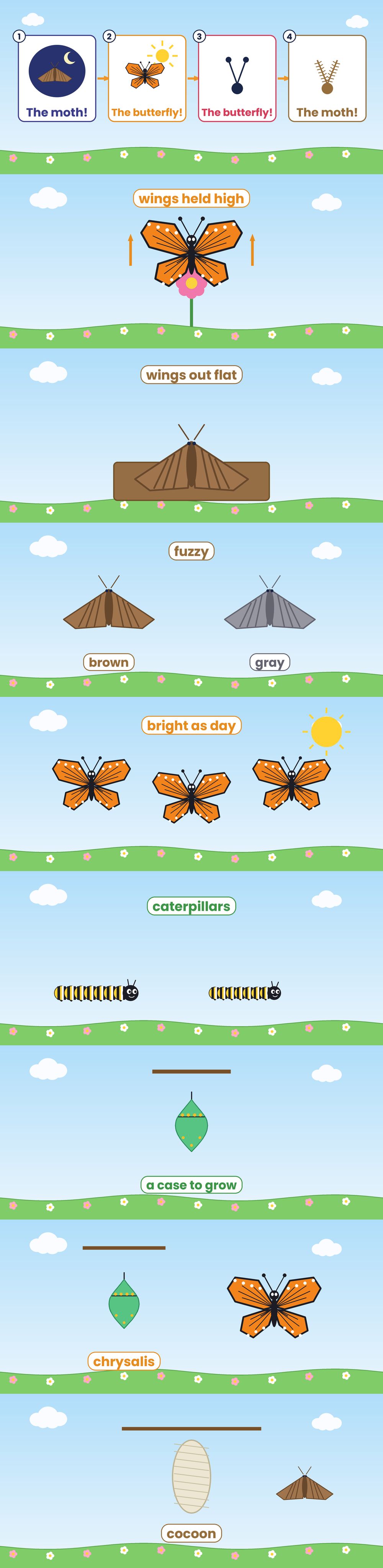
Moths fly at night; butterflies fly in the day. 1Day or night
Butterflies and moths are both insects.
Most butterflies fly in the day. Most moths fly at night.
Butterfly wings up, moth wings flat. 2Wings up or flat
A butterfly usually rests with its wings held up.
Many moths rest with their wings out flat.
Many moths are fuzzy; many butterflies are bright. 3Colors
Many moths look fuzzy, brown or gray.
Many butterflies are bright and colorful.
Both begin as caterpillars. 4Both start as caterpillars
Butterflies and moths both start as caterpillars.
Each caterpillar changes inside a case.
Chrysalis for a butterfly, cocoon for a moth. 5Chrysalis or cocoon
A butterfly's case is a chrysalis.
Many moths spin a soft cocoon.
Key words
- butterfly
- An insect that usually flies in the day and has clubbed antennae.
- moth
- An insect that usually flies at night; many have feathery antennae.
- antennae
- The two feelers on an insect's head.
- chrysalis
- The hard case a caterpillar makes before it becomes a butterfly.
- cocoon
- The soft silk case many moths spin.
Try it: butterfly or moth?
Listen to each clue. Is it a butterfly or a moth?
- Flies mostly at night.Most moths fly at night.
- Flies mostly in the day.Most butterflies fly in the day.
- Antennae with little clubs at the tips.Butterflies have clubbed antennae.
- Antennae that look like feathers.Many moths have feathery antennae.
- Spins a soft cocoon.Many moths spin cocoons.
Quick quiz
Read each question out loud. Children call out the answer, then tap it.
1. Who flies mostly at night?
Show the answer
the moth. Most moths fly at night.
2. Who flies mostly in the day?
Show the answer
the butterfly. Most butterflies fly in the day.
3. Whose antennae have clubs at the tips?
Show the answer
the butterfly. Butterfly antennae end in clubs.
4. Whose antennae look like feathers?
Show the answer
the moth. Many moth antennae are feathery.
For grown-ups: teaching this lesson
Time: 15 to 20 minutes, grades 1 and 2.
- Play the song once all the way through.
- Read the five parts above together. Point to the antennae and wings in each picture.
- Play it again. Pause before each chorus answer so the class can call it out.
- Do the butterfly or moth game together.
- Show pictures of butterflies and moths. Children check three clues (day or night, antennae, wings) and sort them. Exit question: whose antennae look like feathers?
Talk about it
- Why might a moth be brown or gray instead of bright?
- How are butterflies and moths the same?
- Have you seen a moth near a light at night?
Standards and resources
- 1-LS3-1Make observations to construct an evidence-based account that young plants and animals are like, but not exactly like, their parents.
- 2-LS4-1Make observations of plants and animals to compare the diversity of life in different habitats.
Teach it next
For teachers
Free to use in class. Play it a few times; it's made to support what students learn in class, not replace it.
About this song
Butterfly or Moth? is a two-minute sing-along for first and second grade about butterflies and moths: most moths fly at night and most butterflies in the day, butterfly antennae have clubs at the tips and many moth antennae look like feathers, with a drawing on screen for every line. The chorus asks and children shout the answers: Who flies mostly at night? The moth! Who flies mostly in the day? The butterfly! Whose antennae have clubs at the tips? The butterfly! Whose antennae look like feathers? The moth! The verses show a butterfly resting with its wings held high, a moth with its wings flat, fuzzy brown and gray moths, bright butterflies, caterpillars, a chrysalis and a cocoon.
How to use it in class Play it once all the way through. Play it again and pause before each answer in the chorus so the class can call it out. On the third play, turn the sound down on the chorus and let them sing it.
K-2 Sing-Alongs
Posts this song's page (video, lyrics and quiz) to a class in Google Classroom.
Spot a mistake? Tell us. Every fix is listed on the Corrections page.
Check yourself
Who flies mostly at night? Whose antennae have clubs?
Show the answer
The moth. The butterfly.
Key terms
- compare and contrast science
- sing along
Lesson pack
Want a free lesson pack for this song?
A lyric sheet with section times, fill-in-the-blank with a word bank, a vocabulary list, a 10-question quiz and exit tickets, all with answer keys. Free for classroom use.
Pick “A lesson pack for one of the songs” on the form and name this song.
Song details
- Subject
- Science & Nature
- Grades
- 1–2
- Length
- 2:05
- Topic
- Telling butterflies and moths apart: most butterflies fly by day and have thin antennae with clubs at the tips; most moths fly at night and have feathery antennae; butterflies make a chrysalis, many moths spin a cocoon
- On YouTube
- Premieres Dec 14, 2026
- Collection
- K-2 Sing-Alongs
- Made with
- Music made with Suno AI from lyrics written for this lesson; drawings and video by Dr. Lewicki, PhD