 Plays from Google Drive
Sing-along · Science & Nature · Grades K–2
Arctic Animals
 Dr. Lewicki, PhD · Premieres on YouTube Nov 29, 2026 · plays here now
Fur and blubber keep them warm on the ice. Lyrics, lesson and printable: https://drlewicki.com/songs/arctic-animals/
Arctic Animals is a two-minute sing-along about how Arctic animals stay warm and live on the ice: the chorus asks and children shout the answers. Made for kindergarten to second grade in the K-2 Sing-Alongs from Dr. Lewicki, PhD.
Parts of the song · 6
Lyrics
Press play on the video and sing along with the words below.
Chorus
Verse 1
Chorus
Verse 2
Final Chorus
Outro
Lesson · read it together
Let's learn: Arctic animals
Arctic animals live far up north, where it is icy and cold. Read this part together, point to how each animal stays warm.
After this lesson, children can
- Say where the Arctic is: far north, where it is icy and cold.
- Tell how thick fur and blubber keep Arctic animals warm.
- Name Arctic animals: polar bears, arctic foxes, walruses and seals.
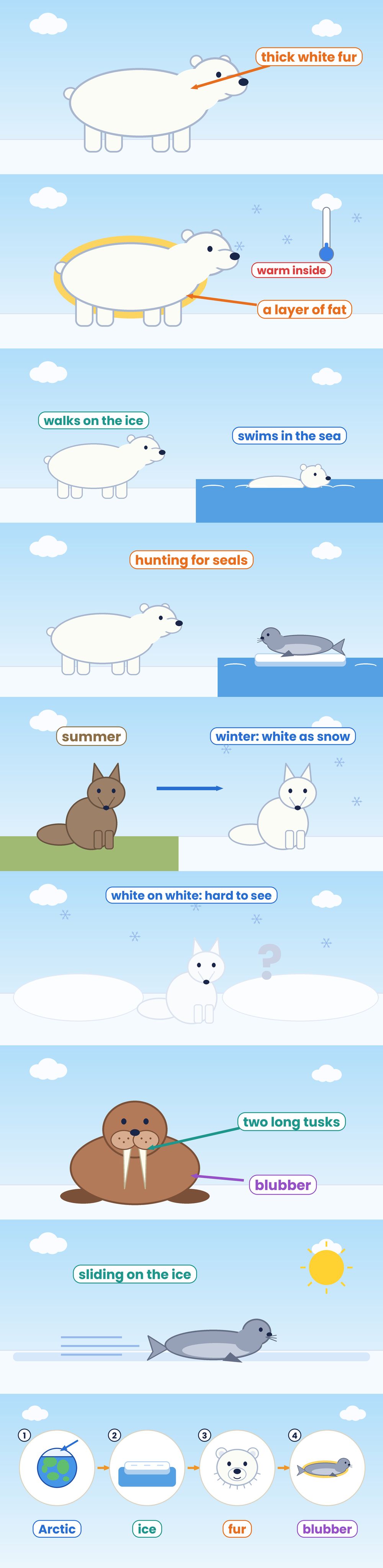
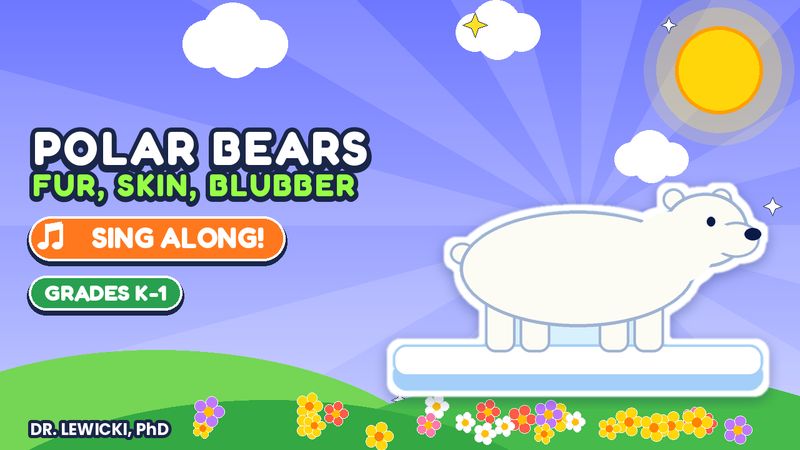
A polar bear has thick white fur and a layer of fat to keep it warm. 1Thick white fur
A polar bear's thick fur keeps out the cold.
Under its skin is a thick layer of fat that keeps it warm inside.
It walks on the ice and swims in the sea, hunting for seals. 2On the ice and in the sea
Polar bears walk and hunt on the sea ice, the frozen top of the ocean.
They are strong swimmers, and seals are their main food.
The arctic fox turns white as snow, so it can hide wherever it goes. 3White as snow
The arctic fox has brown fur in summer and white fur in winter.
White on white is hard to see, so the fox can hide in the snow.
A walrus has blubber and two long tusks. 4Blubber and tusks
Blubber is a thick layer of fat under the skin. It keeps walruses and seals warm in icy water.
A walrus uses its long tusks to pull itself up onto the ice.
A seal slides on ice from dawn to dusk. 5Sliding on the ice
Seals slide on their bellies across the ice and swim in the cold sea.
Arctic, ice, fur, blubber: Arctic animals are tough and bold!
Key words
- Arctic
- The icy, cold land and sea far up north.
- sea ice
- The frozen top of the ocean, where Arctic animals walk and hunt.
- fur
- Thick hair that keeps an animal warm.
- blubber
- A thick layer of fat under the skin of seals and walruses.
- tusk
- A very long tooth, like the two a walrus has.
Try it: which Arctic animal?
Listen to each clue and tap the animal.
- I have thick white fur, and I hunt seals on the ice.Polar bears hunt on the sea ice.
- My fur turns white as snow in winter.White fur helps the arctic fox hide.
- I have two long tusks and lots of blubber.A walrus has tusks and blubber.
- I slide on my belly across the ice.Seals slide on the ice and swim in the sea.
- I'm a strong swimmer with a layer of fat under my fur.Polar bears swim well and stay warm.
Quick quiz
Read each question out loud. Children call out the answer, then tap it.
1. Where do polar bears live?
Show the answer
The Arctic. Polar bears live far north in the icy Arctic.
2. What covers a polar bear?
Show the answer
Thick fur. Thick fur keeps out the cold.
3. What fat keeps a seal warm?
Show the answer
Blubber. Blubber is a thick layer of fat.
4. Why does the arctic fox turn white?
Show the answer
To hide in the snow. White on white is hard to see.
For grown-ups: teaching this lesson
Time: 15 to 20 minutes, kindergarten to second grade.
- Play the song once all the way through.
- Read the five parts above together. Point to the fur, the fat and the ice in each picture.
- Play it again. Pause before each chorus answer so the class can call it out.
- Do the which-animal game together.
- Blubber test: children put a hand in ice water, then again inside a glove packed with shortening, and compare. Exit question: what keeps a seal warm?
Talk about it
- How do you stay warm in winter? (A coat, a hat, mittens: like fur!)
- Why is it good for a polar bear to be white? (It is hard to see on the ice.)
- What would happen if the sea ice melted? (Polar bears would have a harder time hunting seals.)
Standards and resources
- K-ESS3-1Use a model to represent the relationship between the needs of different plants or animals (including humans) and the places they live.
- 1-LS1-1Use materials to design a solution to a human problem by mimicking how plants and/or animals use their external parts to help them survive, grow, and meet their needs.
Teach it next
For teachers
Free to use in class. Play it a few times; it's made to support what students learn in class, not replace it.
About this song
Arctic Animals is a two-minute sing-along for kindergarten to second grade about how Arctic animals stay warm and live on the ice, with a drawing on screen for every line. The chorus asks and children shout the answers: Where do polar bears live? The Arctic! What covers a polar bear? Thick fur! What fat keeps a seal warm? Blubber! What do they walk and hunt on? Sea ice! The verses show a polar bear with thick white fur and a layer of fat walking on the ice, swimming and hunting seals, an arctic fox turning white to hide in the snow, a walrus with blubber and two long tusks, and a seal sliding on the ice.
How to use it in class Play it once all the way through. Play it again and pause before each answer in the chorus so the class can call it out. On the third play, turn the sound down on the chorus and let them sing it.
K-2 Sing-Alongs
Posts this song's page (video, lyrics and quiz) to a class in Google Classroom.
Spot a mistake? Tell us. Every fix is listed on the Corrections page.
Check yourself
What covers a polar bear? What fat keeps a seal warm?
Show the answer
Thick fur. Blubber.
Key terms
- blubber
- how do arctic animals stay warm
- walrus
- arctic fox
- seal
- winter animals
- kindergarten science
- animal habitats
- sing along
Lesson pack
Want a free lesson pack for this song?
A lyric sheet with section times, fill-in-the-blank with a word bank, a vocabulary list, a 10-question quiz and exit tickets, all with answer keys. Free for classroom use.
Pick “A lesson pack for one of the songs” on the form and name this song.
Song details
- Subject
- Science & Nature
- Grades
- K–2
- Length
- 2:04
- Topic
- How Arctic animals stay warm and live on the ice: polar bears have thick fur and fat, seals and walruses have blubber, the arctic fox turns white in winter
- On YouTube
- Premieres Nov 29, 2026
- Collection
- K-2 Sing-Alongs
- Music style
- Bright acoustic children's folk-pop, 112 BPM major-key bounce with unhurried phrasing and held notes; warm clear female lead sings a simple narrow-range melody in dry, up-front half-spoken talk-sing, while children shout each answer after a beat of space; clear foreground vocals, chorus starts right away; strummed ukulele, handclaps, plucked upright bass and glockenspiel chimes carry the verses into a full-group final chorus and children-led outro.
- Lead vocal
- Female
- Made with
- Music made with Suno AI from lyrics written for this lesson; drawings and video by Dr. Lewicki, PhD