 Plays from Google Drive
Sing-along · Science & Nature · Grades K–1
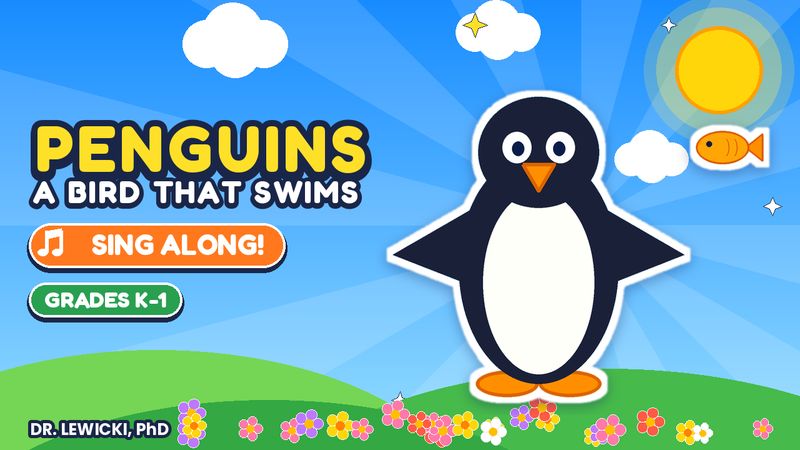
Penguins
 Dr. Lewicki, PhD · Premieres on YouTube Nov 30, 2026 · plays here now
A penguin is a bird that swims. Lyrics, lesson and printable: https://drlewicki.com/songs/penguins/
Penguins is a two-minute sing-along about penguins: birds that swim instead of fly: the chorus asks and children shout the answers. Made for kindergarten and first grade in the K-2 Sing-Alongs from Dr. Lewicki, PhD.
Parts of the song · 6
Lyrics
Press play on the video and sing along with the words below.
Chorus
Verse 1
Chorus
Verse 2
Final Chorus
Outro
Lesson · read it together
Let's learn: penguins
Penguins are birds that swim instead of fly. Read this part together, waddle and swim like a penguin.
After this lesson, children can
- Say that penguins are birds: they have feathers and lay eggs.
- Tell how penguins use flippers to swim instead of fly.
- Say how fat, oily feathers and huddling keep penguins warm.
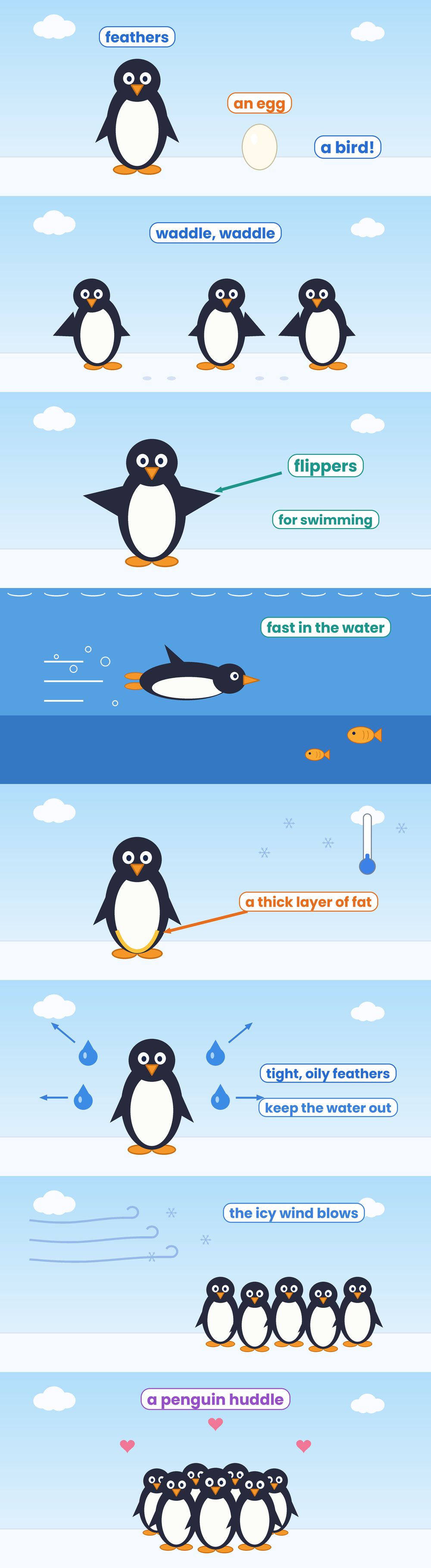
A penguin has feathers and lays an egg. It walks with a waddle on two short legs. 1A penguin is a bird
Penguins are birds. Like all birds, they have feathers and lay eggs.
On land they waddle on two short legs, or slide on their bellies.
Its wings are flippers that help it glide through the water. 2Flippers for swimming
Penguins can't fly. Their wings are flippers.
In the water, they flap their flippers and zoom along to catch fish.
A thick layer of fat keeps the cold away. 3A thick layer of fat
Under the skin, a thick layer of fat keeps penguins warm.
It works like a warm blanket inside their body.
Tight, oily feathers keep the water out. 4Tight, oily feathers
Penguin feathers are short, tight and oily.
Water runs right off, so the penguin stays dry underneath.
When the icy wind blows, they stand in a crowd: a penguin huddle! 5A penguin huddle
When the icy wind blows, penguins stand close together in a huddle.
Most penguins live in the southern half of the world, and some live on the ice of Antarctica.
Key words
- bird
- An animal with feathers that lays eggs.
- flipper
- A flat wing or arm that helps an animal swim.
- waddle
- Walk with short steps, rocking side to side.
- feathers
- What covers a bird's body.
- huddle
- Stand close together to stay warm.
Try it: true or false?
Read each sentence out loud. Is it true or false?
- A penguin is a bird.It has feathers and lays eggs.
- Penguins fly high in the sky.Penguins can't fly. They swim!
- Penguins eat fish.They catch fish in the water.
- Oily feathers keep the water out.Water runs right off.
- Penguins huddle to stay cool.They huddle to stay warm.
- Penguins lay eggs.All birds lay eggs.
Quick quiz
Read each question out loud. Children call out the answer, then tap it.
1. Is a penguin a bird?
Show the answer
Yes, it is. Penguins have feathers and lay eggs.
2. Can a penguin fly?
Show the answer
No, it swims. Its wings are flippers for swimming.
3. What does a penguin eat?
Show the answer
Fish. Penguins catch fish.
4. How do penguins stay warm?
Show the answer
They huddle. Standing close keeps them warm.
For grown-ups: teaching this lesson
Time: 15 minutes, kindergarten and first grade.
- Play the song once all the way through.
- Read the five parts above together. Waddle, flap your flippers and huddle as you read.
- Play it again. Pause before each chorus answer so the class can call it out.
- Do the true-or-false game together.
- Oily feather test: color a paper penguin, rub one half with a crayon "oil" coat, then drip water on both halves and compare. Exit question: can a penguin fly?
Talk about it
- How is a penguin like other birds? How is it different?
- Why do you think penguins need to swim fast? (To catch fish and escape seals.)
- When do people huddle to stay warm?
Standards and resources
- 1-LS1-1Use materials to design a solution to a human problem by mimicking how plants and/or animals use their external parts to help them survive, grow, and meet their needs.
- K-LS1-1Use observations to describe patterns of what plants and animals (including humans) need to survive.
Teach it next
For teachers
Free to use in class. Play it a few times; it's made to support what students learn in class, not replace it.
About this song
Penguins is a two-minute sing-along for kindergarten and first grade about penguins: birds that swim instead of fly, with a drawing on screen for every line. The chorus asks and children shout the answers: Is a penguin a bird? Yes, it is! Can a penguin fly? No, it swims! What does a penguin eat? Fish! How do penguins stay warm? They huddle! The verses show that a penguin has feathers and lays an egg, waddles on two short legs, swims with its flippers, and stays warm with a layer of fat, tight oily feathers and a huddle.
How to use it in class Play it once all the way through. Play it again and pause before each answer in the chorus so the class can call it out. On the third play, turn the sound down on the chorus and let them sing it.
K-2 Sing-Alongs
Posts this song's page (video, lyrics and quiz) to a class in Google Classroom.
Spot a mistake? Tell us. Every fix is listed on the Corrections page.
Check yourself
Can a penguin fly? How do penguins stay warm?
Show the answer
No, it swims. They huddle.
Key terms
- is a penguin a bird
- can penguins fly
- winter animals
- polar animals
- kindergarten science
- sing along
Lesson pack
Want a free lesson pack for this song?
A lyric sheet with section times, fill-in-the-blank with a word bank, a vocabulary list, a 10-question quiz and exit tickets, all with answer keys. Free for classroom use.
Pick “A lesson pack for one of the songs” on the form and name this song.
Song details
- Subject
- Science & Nature
- Grades
- K–1
- Length
- 2:05
- Topic
- Penguins are birds that cannot fly: they have feathers, lay eggs, swim with flippers, eat fish, and huddle together to stay warm on the ice
- On YouTube
- Premieres Nov 30, 2026
- Collection
- K-2 Sing-Alongs
- Music style
- Bright acoustic children's folk-pop, 112 BPM major-key bounce with unhurried phrasing and held notes; warm clear female lead sings a simple narrow-range melody in dry, up-front half-spoken talk-sing, while children shout each answer after a beat of space; clear foreground vocals, chorus starts right away; strummed ukulele, handclaps, plucked upright bass and glockenspiel chimes carry the verses into a full-group final chorus and children-led outro.
- Lead vocal
- Female
- Made with
- Music made with Suno AI from lyrics written for this lesson; drawings and video by Dr. Lewicki, PhD