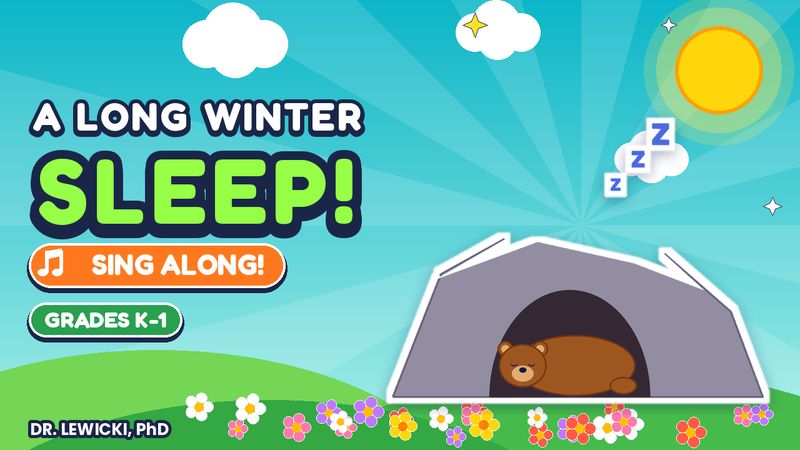
 Plays from Google Drive
Sing-along · Science & Nature · Grades K–1
Hibernation
 Dr. Lewicki, PhD · Premieres on YouTube Dec 1, 2026 · plays here now
The bear eats lots of food in the fall, sleeps all winter in a den, and wakes up in the spring. Lyrics and more: https://drlewicki.com/songs/hibernation-song/
Hibernation is a two-minute sing-along about animals that sleep through the winter: the chorus asks four questions and children shout the answers (the bear, in a den, eat lots of food, in the spring). Made for grades K-1 in the K-2 Sing-Alongs from Dr. Lewicki, PhD.
Parts of the song · 6
Lyrics
Press play on the video and sing along with the words below.
Chorus
Verse 1
Chorus
Verse 2
Final Chorus
Outro
Lesson · read it together
Let's learn: hibernation
Some animals sleep through the cold winter. That long winter sleep is called hibernation. Read this part together, act out how a bear gets ready for winter.
After this lesson, children can
- Say what hibernation is: a long, deep winter sleep.
- Tell how a bear gets ready: it eats a lot in the fall, then sleeps in a den.
- Name other animals that hibernate, and say when they wake up.
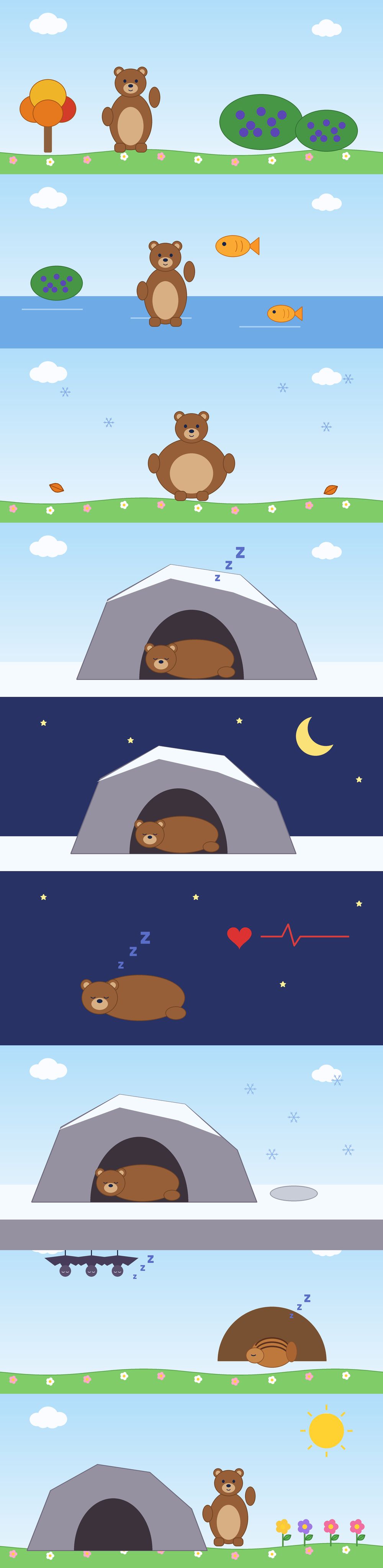
All fall long, the bear eats and eats: berries and fish and other treats. 1Eat, eat, eat
In the fall, food is easy to find. A bear eats and eats: berries, nuts, fish and more.
It is getting ready for winter, when food is hard to find.
It gets nice and fat for the winter cold, then curls up in its den. 2Nice and fat
The bear gets nice and fat. Its body fat is stored food for the winter.
Then it curls up in a den, a safe place like a cave or a hollow under a tree.
Its heart beats slow, and its breathing too. 3A long winter sleep
While a bear hibernates, its heart beats very slowly, and it breathes slowly too.
Its body uses very little energy, so its fat lasts all winter.
It doesn't eat the whole winter through. 4No food all winter
A hibernating bear doesn't eat or drink all winter.
It lives on the fat it stored in the fall.
Bats and chipmunks hibernate as well. Then spring comes back, and they wake. 5Bats, chipmunks, and spring
Bats hibernate in caves, and chipmunks hibernate in burrows. Chipmunks wake up now and then to nibble food they stored.
When warm spring weather comes back, the animals wake up and go looking for food.
Key words
- hibernate
- Sleep deeply through the winter.
- den
- A safe home, like a cave or a hollow.
- winter
- The coldest season, when food is hard to find.
- fat
- Stored food inside an animal's body.
- spring
- The season after winter, when the weather warms up.
Try it: before, during or after?
Listen to each one. Is it before, during or after hibernation?
- The bear eats lots of berries.In the fall, the bear eats and eats.
- The bear sleeps in its den with a slow heartbeat.That's hibernation.
- The bear walks out of its den into the warm sun.It wakes up in spring.
- The bear catches lots of fish to get fat.Getting ready for winter.
- Snow covers the den, and the bear doesn't eat.It lives on its stored fat.
Quick quiz
Read each question out loud. Children call out the answer, then tap it.
1. Who sleeps all winter?
Show the answer
The bear. Bears hibernate in winter.
2. Where does it sleep?
Show the answer
In a den. A den keeps the bear safe.
3. What does it do in the fall?
Show the answer
Eat lots of food. It eats a lot to store fat.
4. When does it wake up?
Show the answer
In the spring. Warm spring weather wakes it.
For grown-ups: teaching this lesson
Time: 15 minutes, kindergarten and first grade.
- Play the song once all the way through.
- Read the five parts above together. Act out eating, curling up, sleeping slowly and waking up.
- Play it again. Pause before each chorus answer so the class can call it out.
- Do the before-during-after game together.
- Make a class den: drape a blanket over a table, and have "bears" take turns hibernating inside while the class counts slow breaths. Exit question: when does a bear wake up?
Talk about it
- Why do bears eat so much in the fall?
- Why might animals sleep through the winter? (Food is hard to find, and it's cold.)
- What do people do in winter to stay warm and fed?
Standards and resources
- K-LS1-1Use observations to describe patterns of what plants and animals (including humans) need to survive.
- K-ESS2-1Use and share observations of local weather conditions to describe patterns over time.
Teach it next
For teachers
Free to use in class. Play it a few times; it's made to support what students learn in class, not replace it.
About this song
Hibernation, in a two-minute sing-along for kindergarten and first grade, with a drawing on screen for every line. The chorus asks and children shout the answers: who sleeps all winter? The bear! Where does it sleep? In a den! What does it do in the fall? Eat lots of food! When does it wake up? In the spring! The verses follow a bear eating berries and fish all fall, curling up in its den, sleeping with a slow heartbeat, and waking in spring, and show that bats and chipmunks hibernate too.
How to use it in class Play it once all the way through. Play it again and pause before each answer in the chorus so the class can call it out. On the third play, turn the sound down on the chorus and let them sing it.
K-2 Sing-Alongs
Posts this song's page (video, lyrics and quiz) to a class in Google Classroom.
Spot a mistake? Tell us. Every fix is listed on the Corrections page.
Check yourself
Why does the bear eat lots of food in the fall?
Show the answer
So it is nice and fat for the winter: it doesn't eat while it hibernates.
Key terms
- hibernate
- animals in winter
- bear hibernation
- bears sleep all winter
- den
- bats and chipmunks hibernate
- winter animals
- kindergarten science
- sing along
Lesson pack
Want a free lesson pack for this song?
A lyric sheet with section times, fill-in-the-blank with a word bank, a vocabulary list, a 10-question quiz and exit tickets, all with answer keys. Free for classroom use.
Pick “A lesson pack for one of the songs” on the form and name this song.
Song details
- Subject
- Science & Nature
- Grades
- K–1
- Length
- 2:04
- Topic
- Some animals hibernate: eat in fall, sleep in a den, wake in spring
- On YouTube
- Premieres Dec 1, 2026
- Collection
- K-2 Sing-Alongs
- Music style
- bright acoustic children's folk-pop, the song starts straight on the chorus, ukulele, handclaps, upright bass, glockenspiel, 112 BPM, warm clear female lead on a simple narrow-range melody, a group of children shout each answer after a beat of space, unhurried phrasing, held notes, major key, clear foreground vocals
- Lead vocal
- Female
- Made with
- Music made with Suno AI from lyrics written for this lesson; drawings and video by Dr. Lewicki, PhD