 Plays from Google Drive
Sing-along · Math & Counting · Grades 1–2
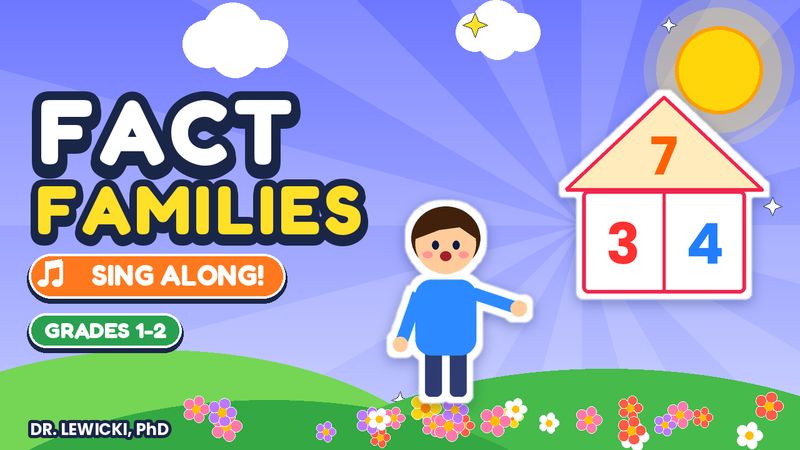
Fact Families
 Dr. Lewicki, PhD · Premieres on YouTube Dec 1, 2026 · plays here now
Three numbers make four related facts. Lyrics, lesson and printable: https://drlewicki.com/songs/fact-families/
Fact Families is a two-minute sing-along about fact families: three numbers that make four related facts. The chorus asks and children shout the answers. Made for first and second grade in the K-2 Sing-Alongs from Dr. Lewicki, PhD.
Parts of the song · 6
Lyrics
Press play on the video and sing along with the words below.
Chorus
Verse 1
Chorus
Verse 2
Final Chorus
Outro
Lesson · read it together
Let's learn: fact families
A fact family is three numbers that make four related facts: two adding and two subtracting. Read this part together, use the fact family house.
After this lesson, children can
- Name the parts and the whole in a fact family.
- Write the two addition facts and two subtraction facts for three numbers.
- Use addition to help solve subtraction.
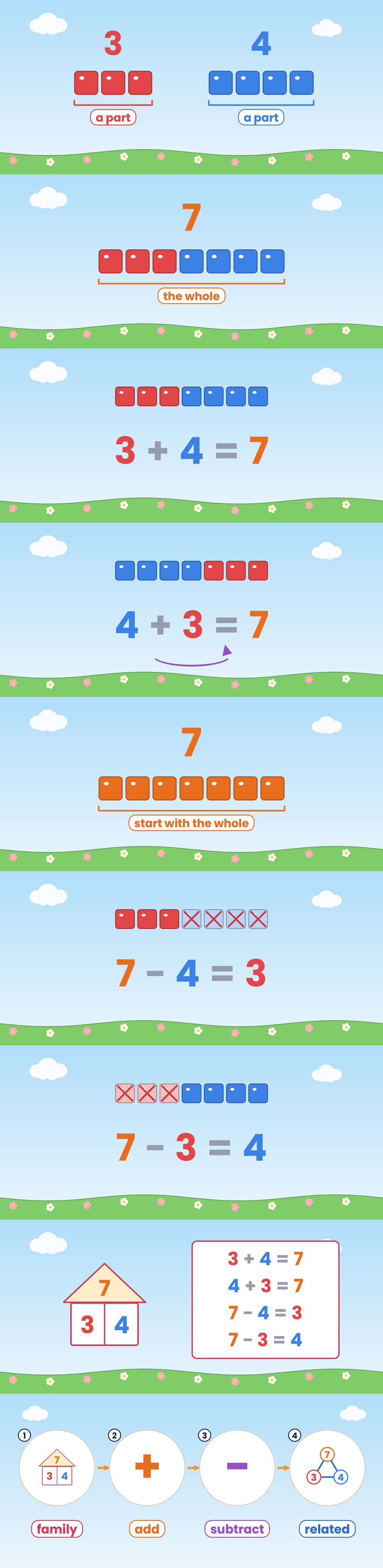
Three and four are the parts. Seven is the whole. 1Parts and the whole
In the fact family 3, 4 and 7, the parts are 3 and 4.
The whole is 7.
Add the parts and the whole is found. Then switch the parts, the other way round. 2Add the parts
3 + 4 = 7.
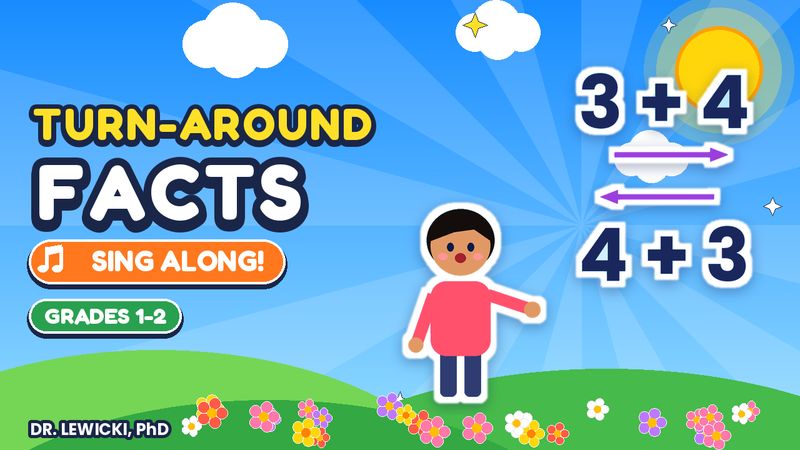
Switch the parts: 4 + 3 = 7. Same whole!
Now start with seven, the whole. Take away four, and that leaves three. 3Start with the whole
For subtraction, start with the whole: 7.
7 − 4 = 3.
Take away three, and that leaves four. 4Take away the other part
Take away the other part: 7 − 3 = 4.
Subtraction undoes addition.
Four related facts, and there are no more. 5Four related facts
3 + 4 = 7, 4 + 3 = 7, 7 − 4 = 3, 7 − 3 = 4.
Two to add and two to subtract: that's a fact family.
Key words
- fact family
- Three numbers that make two addition and two subtraction facts.
- part
- One of the numbers that make the whole.
- whole
- The total the parts make.
- related
- Connected; in the same family.
- subtract
- Take away a part from the whole.
Try it: find the missing number
Use the fact family 3, 4, 7. Tap the missing number.
- 3 + 4 = ?The parts make the whole: 7.
- 4 + 3 = ?Switch the parts: still 7.
- 7 − 4 = ?Take away 4 from 7: 3.
- 7 − 3 = ?Take away 3 from 7: 4.
- ? + 3 = 74 + 3 = 7.
Quick quiz
Read each question out loud. Children call out the answer, then tap it.
1. Three, four and seven make a fact?
Show the answer
Family. They're a fact family.
2. How many facts are in the family?
Show the answer
Four. Two add and two subtract.
3. Three plus four, and four plus three?
Show the answer
Seven. Both make 7.
4. Seven minus four is?
Show the answer
Three. 7 − 4 = 3.
For grown-ups: teaching this lesson
Time: 15 to 20 minutes, first and second grade.
- Play the song once all the way through.
- Read the five parts above together. Build each fact with two colors of cubes.
- Play it again. Pause before each chorus answer so the class can call it out.
- Do the missing-number game together.
- Fact family houses: each child gets a paper house with a whole on the roof and two parts in the windows, and writes the four facts on the door. Exit question: what are the four facts for 2, 5 and 7?
Talk about it
- Why does 7 − 4 = 3 belong with 3 + 4 = 7?
- Can 5, 5 and 10 make a fact family? How many facts? (Only two: 5 + 5 = 10 and 10 − 5 = 5.)
- How can adding help you subtract?
Standards and resources
- 1.OA.B.4Understand subtraction as an unknown-addend problem. For example, subtract 10 − 8 by finding the number that makes 10 when added to 8.
- 1.OA.C.6Add and subtract within 20, demonstrating fluency for addition and subtraction within 10. Use strategies such as using the relationship between addition and subtraction.
Teach it next
For teachers
Free to use in class. Play it a few times; it's made to support what students learn in class, not replace it.
About this song
Fact Families is a two-minute sing-along for first and second grade about fact families: three numbers that make four related facts, with a drawing on screen for every line. The chorus asks and children shout the answers: Three, four and seven make a fact? Family! How many facts are in the family? Four! Three plus four, and four plus three? Seven! Seven minus four is? Three! The verses call three and four the parts and seven the whole, add the parts and then switch them, then start with the whole and take away four to leave three, and take away three to leave four: four related facts.
How to use it in class Play it once all the way through. Play it again and pause before each answer in the chorus so the class can call it out. On the third play, turn the sound down on the chorus and let them sing it.
K-2 Sing-Alongs
Posts this song's page (video, lyrics and quiz) to a class in Google Classroom.
Spot a mistake? Tell us. Every fix is listed on the Corrections page.
Check yourself
The family is 3, 4 and 7. What are its two subtraction facts?
Show the answer
7 − 4 = 3 and 7 − 3 = 4.
Key terms
- addition and subtraction facts
- related facts
- part part whole
- sing along
Lesson pack
Want a free lesson pack for this song?
A lyric sheet with section times, fill-in-the-blank with a word bank, a vocabulary list, a 10-question quiz and exit tickets, all with answer keys. Free for classroom use.
Pick “A lesson pack for one of the songs” on the form and name this song.
Song details
- Subject
- Math & Counting
- Grades
- 1–2
- Length
- 2:05
- Topic
- Fact families: three numbers (two parts and a whole) make four related facts, two addition and two subtraction
- On YouTube
- Premieres Dec 1, 2026
- Collection
- K-2 Sing-Alongs
- Music style
- Bright acoustic children's folk-pop, 112 BPM major-key bounce with unhurried phrasing and held notes; warm clear female lead sings a simple narrow-range melody in dry, up-front half-spoken talk-sing, while children shout each answer after a beat of space; clear foreground vocals, chorus starts right away; strummed ukulele, handclaps, plucked upright bass and glockenspiel chimes carry the verses into a full-group final chorus and children-led outro.
- Lead vocal
- Female
- Made with
- Music made with Suno AI from lyrics written for this lesson; drawings and video by Dr. Lewicki, PhD