 Plays from Google Drive
Sing-along · Math & Counting · Grades 1–2
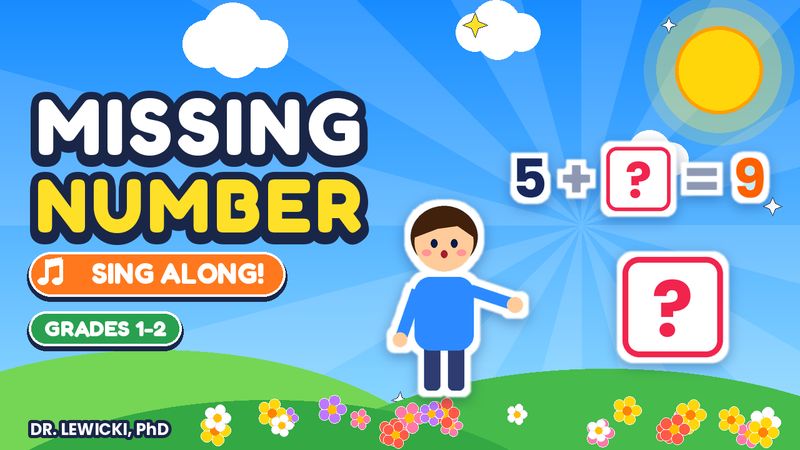
Missing Number
 Dr. Lewicki, PhD · Premieres on YouTube Dec 2, 2026 · plays here now
Count on or subtract to find the missing number. Lyrics, lesson and printable: https://drlewicki.com/songs/missing-number/
Missing Number is a two-minute sing-along about missing numbers: finding the unknown part of an addition sentence. The chorus asks and children shout the answers. Made for first and second grade in the K-2 Sing-Alongs from Dr. Lewicki, PhD.
Parts of the song · 6
Lyrics
Press play on the video and sing along with the words below.
Chorus
Verse 1
Chorus
Verse 2
Final Chorus
Outro
Lesson · read it together
Let's learn: finding the missing number
Sometimes a number is hiding in an addition sentence. We can find it by counting on or by subtracting. Read this part together, use counters to find each missing number.
After this lesson, children can
- Find a missing part in an addition sentence, like 5 + ? = 9.
- Count on from the part you know to the whole.
- Subtract the known part from the whole to find the missing part.
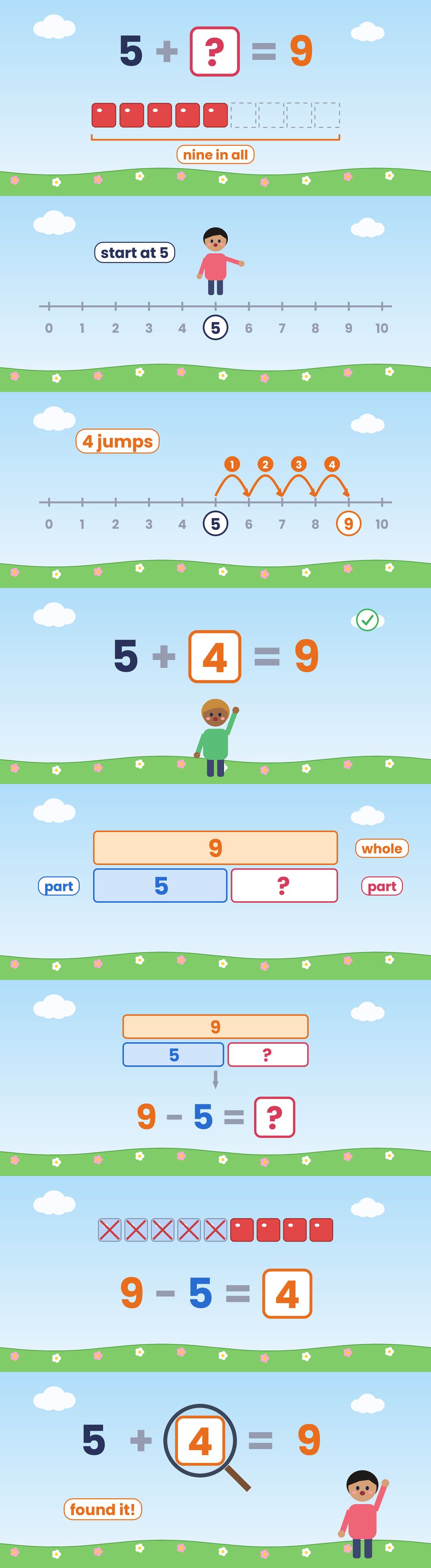
Five plus a missing part makes nine. 1A number is hiding
In 5 + ? = 9, one part is hiding.
We know one part is 5 and the whole is 9.
Start at five and count up the line: six, seven, eight, nine: four jumps more. 2Count on
Start at 5 and count on to 9: 6, 7, 8, 9.
That's 4 jumps. The missing number is 4.
So the missing number must be four. 3Found it: four
5 + 4 = 9.
Check it: 5 and 4 more make 9. Yes!
You know the whole, and you know one part. Subtracting gives the other. 4Part, part, whole
You know the whole (9) and one part (5).
Subtract to find the other part: 9 − 5.
Nine take away five leaves four. The unknown number is no mystery. 5Nine take away five
9 − 5 = 4.
Counting on and subtracting both find the missing number: 4!
Key words
- missing number
- A number that is hiding in a number sentence.
- unknown
- Not known yet.
- part
- One of the numbers that make the whole.
- whole
- The total the parts make.
- count on
- Start at a number and keep counting up.
Try it: find the missing number
Read each one out loud. Tap the missing number.
- 5 + ? = 9Count on from 5: 6, 7, 8, 9. Four.
- 2 + ? = 1010 − 2 = 8.
- ? + 3 = 99 − 3 = 6.
- 6 + ? = 6Nothing added: zero.
- 4 + ? = 8Double 4 is 8.
Quick quiz
Read each question out loud. Children call out the answer, then tap it.
1. Five plus what is nine?
Show the answer
Four. 5 + 4 = 9.
2. Two plus what is ten?
Show the answer
Eight. 2 + 8 = 10.
3. What plus three is nine?
Show the answer
Six. 6 + 3 = 9.
4. Six plus what is six?
Show the answer
Zero. 6 + 0 = 6.
For grown-ups: teaching this lesson
Time: 15 to 20 minutes, first and second grade.
- Play the song once all the way through.
- Read the five parts above together. Use counters: put out the part you know, then add more until you reach the whole.
- Play it again. Pause before each chorus answer so the class can call it out.
- Do the missing-number game together.
- Hide and count: put 9 counters out, then hide some under a cup while children watch the rest. How many are hiding? Write the number sentence. Exit question: 7 + ? = 10?
Talk about it
- How can counting on help you find a missing number?
- How can subtracting help?
- Make up your own missing number puzzle for a partner.
Standards and resources
- 1.OA.D.8Determine the unknown whole number in an addition or subtraction equation relating three whole numbers.
- 1.OA.B.4Understand subtraction as an unknown-addend problem.
Teach it next
For teachers
Free to use in class. Play it a few times; it's made to support what students learn in class, not replace it.
About this song
Missing Number is a two-minute sing-along for first and second grade about missing numbers: finding the unknown part of an addition sentence, with a drawing on screen for every line. The chorus asks and children shout the answers: Five plus what is nine? Four! Two plus what is ten? Eight! What plus three is nine? Six! Six plus what is six? Zero! The verses find the missing part of five plus what is nine in two ways: start at five and count up to nine, four jumps; or take the part you know away from the whole, and nine take away five leaves four.
How to use it in class Play it once all the way through. Play it again and pause before each answer in the chorus so the class can call it out. On the third play, turn the sound down on the chorus and let them sing it.
K-2 Sing-Alongs
Posts this song's page (video, lyrics and quiz) to a class in Google Classroom.
Spot a mistake? Tell us. Every fix is listed on the Corrections page.
Check yourself
7 + ? = 10. What is the missing number? How can you check?
Show the answer
3. Count on from 7 (8, 9, 10), or subtract: 10 − 7 = 3.
Key terms
- missing addend
- unknown number addition
- find the missing number
- part part whole
- count on to add
- sing along
Lesson pack
Want a free lesson pack for this song?
A lyric sheet with section times, fill-in-the-blank with a word bank, a vocabulary list, a 10-question quiz and exit tickets, all with answer keys. Free for classroom use.
Pick “A lesson pack for one of the songs” on the form and name this song.
Song details
- Subject
- Math & Counting
- Grades
- 1–2
- Length
- 2:04
- Topic
- Missing numbers: finding the unknown part in an addition sentence by counting on or by subtracting
- On YouTube
- Premieres Dec 2, 2026
- Collection
- K-2 Sing-Alongs
- Music style
- Bright acoustic children's folk-pop, 112 BPM major-key bounce with unhurried phrasing and held notes; warm clear female lead sings a simple narrow-range melody in dry, up-front half-spoken talk-sing, while children shout each answer after a beat of space; clear foreground vocals, chorus starts right away; strummed ukulele, handclaps, plucked upright bass and glockenspiel chimes carry the verses into a full-group final chorus and children-led outro.
- Lead vocal
- Female
- Made with
- Music made with Suno AI from lyrics written for this lesson; drawings and video by Dr. Lewicki, PhD